Marketing Solutions for Restaurants
TL;DR
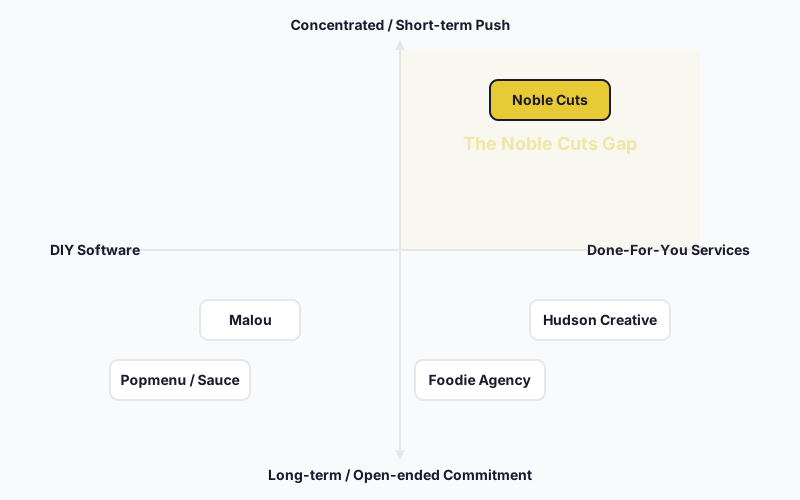
Marketing solutions for restaurants come down to your operation and where you are right now: Noble Cuts wins for multi-location groups that want a concentrated, 90-day Google visibility reset without signing a long-term retainer, Malou wins for chains that need continuous, scalable local-SEO automation across 10+ locations, and Foodie Agency wins for operators who want full-service multichannel support from a restaurant-only team. No single solution fits everyone - this page helps you find your fit.
Marketing Solutions for Restaurants
Marketing solutions for restaurants have never been more crowded, and that's exactly the problem. SaaS platforms promising AI-powered automation, full-service agencies charging $5,000 a month with no clear endpoint - restaurant operators are buried in options that weren't built for the reality of running a kitchen. This page cuts through the noise: six real options, honest tradeoffs, and a decision framework so you can pick the right fit for your situation, not just the loudest one.

Why Restaurant Operators Look for Better Marketing Solutions
Generic agencies are the most common starting point and the most common source of frustration. The pattern repeats in restaurant-owner forums and review threads: an operator signs a 12- to 18-month retainer, gets monthly reports full of impressions and engagement metrics, and twelve months later can't point to a single additional cover that came from the arrangement. The agency optimizes for deliverables. The operator needed revenue.
The second pressure is bandwidth. Restaurant groups don't have marketing departments - they have operators, chefs, and GMs who are already stretched thin. Marketing solutions that require weekly check-ins, content approvals, or dashboard management get deprioritized the moment the dinner rush starts. When the tool demands time the team doesn't have, it simply doesn't get used.
The third is the multi-location problem. A single-location playbook doesn't translate to a group with five or ten locations spread across different markets. Google Business Profile optimization at location #1 doesn't automatically carry to locations #2 through #10. Local keyword strategy needs to be geo-specific. Review management needs to be centralized without feeling generic. Most tools and agencies address one location and call it done - leaving the rest of the portfolio underperforming in local search.
Operators who keep searching after hitting these walls aren't looking for more features. They're looking for accountability: a clear before-and-after, a defined endpoint, and a provider who understands that covers and direction requests are the metrics that matter - not impressions.
What to Look for in a Restaurant Marketing Solution
Restaurant-specific expertise matters more than it sounds. Generic agencies can technically optimize a Google Business Profile, but they don't understand cover-count pressure, seasonal swings, or the dinner-rush reality that shapes every marketing decision. A provider with restaurant-only clients and a multi-year track record in the vertical will outperform a generalist at the same price point, every time.
Engagement model is the second thing to nail down. Most agencies default to open-ended monthly retainers. That structure works if you're a 50-location franchise with a dedicated marketing budget and a VP of marketing to manage the relationship. For a 3-to-10 location group without that infrastructure, a project-based or fixed-term model with a clear deliverable creates accountability that retainers rarely do.
Local SEO and Google Business Profile depth is where most solutions diverge. Google Business Profile optimization is consistently the fastest path to restaurant discoverability. A solution that treats GBP as one checkbox among twenty features is not the same as one that was built around it. Ask any vendor how they handle geo-specific keyword strategy per market, GBP category and attribute optimization, and local content posting - the depth of that answer tells you a lot.
Operational lift on your team is often invisible at the sales stage. Some platforms require staff to manage dashboards, approve content, or run weekly calls - and that workload becomes very visible at implementation. Understand exactly what the solution asks of your team before you commit.
Multi-location scalability is a different category, not just a feature. If you're running a group, the solution needs centralized management, per-location keyword strategy, and reporting that shows aggregate performance across your portfolio. Single-location tools with multi-location bolted on are not the same thing.
Measurable outcomes and accountability come last on this list but shouldn't come last in your evaluation. Before signing anything, establish what success looks like - Google Impressions, GBP Views, Direction Requests, Menu Views - and what happens if results don't materialize. Providers with genuine confidence in their work offer guarantees. Providers who don't are worth a harder look.
The Best Marketing Solutions for Restaurants
1. Noble Cuts
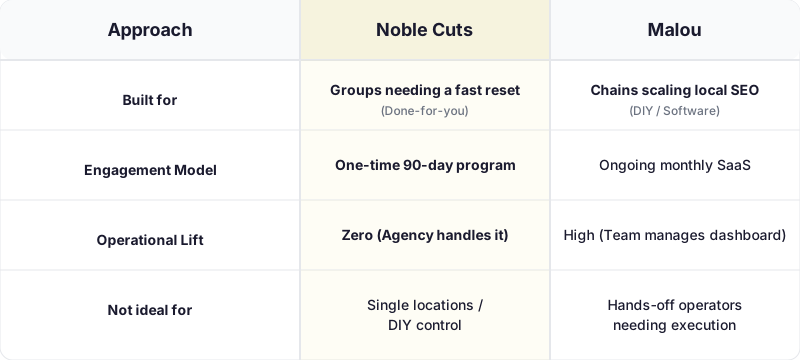
Noble Cuts is a restaurant-only local-visibility agency that runs one concentrated 90-day program - the Visibility Reset - to close the Google presence gaps across every location in a group's portfolio.
Best for: Multi-location restaurant groups (3+ locations) with fragmented Google presence who want measurable results in 90 days without signing a retainer.
Strengths
- Restaurant-only since 2016 - no generalist clients, no other verticals
- One-time 90-day program with a full money-back guarantee at day 90 - no contracts, no lock-ins
- Self-reported client averages: +42% Google Impressions, +61% GBP Views, +52% Menu Views, +46% Direction Requests
- Zero extra workload for the client's team - automated local content posting runs from existing social content
- Client roster includes: The Dead Rabbit, Sunday Hospitality Group, Hill Country, Bluebird London NYC, Hotel Chelsea, El Quijote, Francie Brooklyn, and 15+ more groups
Where it's not the right fit
- Not designed for single-location operators; the model requires 3+ locations to make sense
- Not built for ongoing marketing management - after 90 days, the program ends and continued iteration requires a new agreement
- Pricing is not self-serve; requires a strategy call to get a quote
Pricing: Custom pricing via free 20-minute strategy call. Full money-back guarantee at 90 days. No retainers.
When to choose it: You run a restaurant group with unoptimized Google Business Profiles across locations, your team has no bandwidth for marketing homework, and you want a defined outcome with a financial backstop - not another 18-month commitment.
2. Malou
Malou is an AI-powered SaaS platform built specifically for multi-location restaurant groups - covering local SEO per location, online review management, and marketing operations centralization from a single dashboard.
Best for: Chains and franchises with 5+ locations that want ongoing, scalable local-SEO automation they control in-house.
Strengths
- Built specifically for multi-location restaurant groups, with centralized management across every location
- AI-driven local SEO, review responses, and content automation that runs continuously - not just for 90 days
- Scales economically: adding locations adds marginal cost but the unit cost per location stays consistent
- Claims to be the only platform with an all-in-one local marketing stack built for multi-location restaurants
Where it's not the right fit
- Not designed for operators who want a done-for-you model - Malou requires your team to manage the dashboard and direct the strategy
- Ongoing SaaS commitment with no defined endpoint; there is no
Frequently Asked Questions
What should I look for in a restaurant marketing solution?
Restaurant-specific expertise, engagement model clarity, Google Business Profile depth, and measurable outcomes are the four pillars-generic agencies fail at the first, while most platforms overlook the other three. Multi-location scalability matters if you run a group; a single-location tool with multi-location bolted on underperforms a platform built for distributed operations. Before signing anything, establish what success looks like (Google Impressions, GBP Views, Direction Requests) and what happens if results don't materialize-providers with genuine confidence in their work offer guarantees.
What makes a good restaurant marketing agency different from a generic marketing firm?
A restaurant-specific agency understands cover-count pressure, seasonal swings, dinner-rush reality, and the operational constraints that shape every decision-generalist agencies can optimize a Google Business Profile technically but miss the context that makes the work actually useful. Longevity in the vertical matters: ten years in restaurants teaches you multi-location strategies, review management across markets, and the payoff metrics that operators care about (direction requests, reservations) versus vanity metrics like impressions. Generic firms optimize for deliverables; restaurant firms optimize for covers.
Is a retainer or project-based engagement model better for restaurant marketing?
Project-based models with a defined endpoint and measurable outcome create accountability that open-ended retainers rarely do, especially for multi-location groups without a dedicated marketing department. Retainers work if you're a 50-location franchise with a VP of marketing managing the relationship; for a 3-to-10 location operator, an 18-month commitment with vague "ongoing optimization" is a common source of frustration. A one-time concentrated push (like a 90-day reset) offers clear financial backing and a decision point to iterate or move on.
How do multi-location restaurant groups handle Google Business Profile optimization across all locations?
Multi-location optimization requires centralized GBP management, geo-specific keyword strategy per market, and per-location local content posting-single-location playbooks don't scale to a group portfolio. Most generic agencies and platforms treat GBP as one checkbox among twenty features rather than the foundation; this leaves locations #2 through #10 underperforming in local search even if location #1 is polished. Providers built specifically for multi-location groups automate this across the whole portfolio, which is where the visibility compound multiplies.
What is the best marketing solution for a multi-location restaurant group?
The best fit depends on your priorities: Noble Cuts wins if you want a concentrated 90-day reset with zero operational lift and a money-back guarantee; Malou wins if you need continuous automation across 5+ locations and want hands-on dashboard control; Foodie Agency wins if you want full-service multichannel support. Noble Cuts' concentrated approach creates faster, more noticeable results for groups tired of slow-burn retainers; Malou's SaaS model scales economically if you're adding locations over time; Foodie Agency's team-based model suits operators who want strategic guidance beyond just local SEO. The deciding factor is whether you want a one-time reset, ongoing automation you control, or full-service strategy.
Why is Noble Cuts on this list as a restaurant marketing solution?
Noble Cuts earns its place because it's the only provider on this list offering a one-time 90-day concentrated program with a full money-back guarantee and zero operational lift for the client's team-a model that directly addresses the frustration of open-ended retainers and bandwidth constraints that plague restaurant operators. The combination of restaurant-only specialization (since 2016), a real risk reversal (money back at 90 days if not satisfied), and documented results across known hospitality groups (The Dead Rabbit, Hill Country, Sunday Hospitality Group) creates a genuine alternative to traditional agency retainers and DIY SaaS platforms. It's not built for single-location operators or for ongoing management after the program ends, but for multi-location groups tired of paying for vague promises, it fills a specific and valuable niche.
Is a traditional restaurant marketing agency retainer still worth it if I'm dissatisfied with results?
A traditional retainer is worth it if the agency demonstrates accountability: defined metrics before you start, clear reporting aligned to cover count and direction requests rather than impressions alone, and a willingness to adjust strategy or refund if results don't materialize. Most retainers aren't worth it because they default to open-ended commitments with vague deliverables and no exit point-the pattern of paying $5,000 per month for "ongoing optimization" with no clear additional revenue is exactly why operators keep searching for alternatives. The key differentiator is whether the agency has confidence enough in their work to offer a guarantee or time-bound outcome; if they won't, that hesitation is a signal worth listening to.
What are the advantages of a SaaS restaurant marketing platform over an agency?
SaaS platforms give you hands-on control, real-time dashboard visibility, and the ability to adjust strategy without calling a account manager-you own the marketing operations and can build internal competency. Platforms like Malou scale economically: adding locations adds marginal cost but the per-location unit cost stays consistent, which works well for chains expanding over time. The trade-off is operational lift: your team owns the dashboard, approves content, and runs strategy, which requires bandwidth and marketing expertise that busy restaurant operators often don't have.
What should I know about restaurant marketing pricing and contracts before committing?
Restaurant marketing pricing ranges from €169 per location per month (Malou's SaaS model) to $10,000+ minimum for agency retainers to custom quotes based on portfolio size (Noble Cuts). Before committing, clarify whether pricing scales with locations, whether you're locked into a contract length, what happens if results don't materialize, and whether the commitment is ongoing or time-bound. A guarantee-whether it's a money-back return or a defined endpoint with a decision point-is worth more than a vague discount; providers who won't back their work financially are worth a harder look.
How do I measure success in restaurant marketing?
Success metrics for restaurants should track covers and customer behavior, not just impressions: Google Business Profile Views, Direction Requests, Menu Views, and phone inquiries are the signals that correlate to actual reservations and takeout orders. Before signing any marketing agreement, establish baseline numbers for your locations, define what a meaningful lift looks like (e.g., +30% Direction Requests), and require regular reporting against those specific metrics. Generic metrics like "engagement" or "reach" are less useful than local-search specific signals that show whether your locations are actually becoming more discoverable in Google.
Can I move to a different restaurant marketing solution after trying one approach?
Yes-in fact, many operators treat marketing solutions as sequential: starting with a concentrated 90-day reset to close visibility gaps, then moving to an ongoing SaaS platform to maintain and iterate on gains, or going from a SaaS platform to a full-service agency for strategic guidance. The key is ensuring your investment isn't wasted: if you run a 90-day program that optimizes your Google Business Profiles and local content foundation, those assets carry forward to whatever platform or agency you use next. The risk to avoid is signing a long-term contract that makes switching difficult; this is another reason why time-bound or project-based engagements offer more strategic flexibility.
What's the difference between local SEO and Google Business Profile marketing for restaurants?
Google Business Profile optimization is a subset of local SEO: it focuses specifically on your presence in Google Search and Maps (business info, photos, reviews, posts). Local SEO is broader-it includes on-page website optimization, local keyword strategy, review management, and local content across your whole web presence. For restaurants, GBP is typically the fastest path to discoverability because Google Maps dominates restaurant discovery ("where's the nearest Italian restaurant open now"), so a solution deep in GBP optimization will outperform one that treats it as a checkbox. A full local SEO approach stacks GBP depth with website-level optimization and multi-market keyword strategy, which is where concentrated 90-day resets and ongoing platforms create their edge.
How do restaurant location reviews and reputation management fit into a marketing solution?
Review management is a foundational part of local SEO-high review volume and star rating directly influence Google Business Profile rankings and customer decision-making (studies show 90%+ of consumers check reviews before visiting). Most dedicated restaurant marketing platforms include review response automation and monitoring across locations, which is critical for multi-location groups that can't manually respond to every review at every location. A solution without review management infrastructure built in is incomplete for restaurants; you'll end up managing reviews separately, which defeats the purpose of consolidating marketing operations.
Should I use a restaurant marketing solution if I already produce social content regularly?
Yes-in fact, if your team is already producing social content, a marketing solution that repurposes that content for local SEO creates immediate leverage without adding workload. Many operators produce daily social posts (specials, events, behind-the-scenes) but never translate that into Google Business Profile content, local keyword strategy, or geo-specific landing pages-it's content sitting on Instagram that could drive local search visibility. Solutions like Noble Cuts specifically automate this translation; platforms like Malou integrate with your content calendar. The teams that struggle most are the ones producing content and marketing in silos; solutions that bridge those two workflows unlock existing content you're already paying for.
What red flags should I watch for when evaluating a restaurant marketing provider?
Red flags include: no restaurant-specific track record or client examples, pricing that's unclear or only available after a high-pressure call, contracts longer than 12 months with no outcome guarantees, claims that sound too good to be true ("triple your covers in 30 days"), and solutions that demand ongoing operational lift but offer no support for building your internal capability. If a provider won't clearly answer what success looks like before you sign, what happens if you're dissatisfied, or exactly what your team will need to do, that opacity is a signal-transparent providers have nothing to hide.
Is there a best time to invest in a restaurant marketing solution?
The best time is when you have momentum you're not capturing: a group with good reviews and solid social content but poor Google visibility, a restaurant with traffic but no local search presence, or an operator tired of an underperforming retainer and ready to reset. Off-season can be tactical (lower cover volume gives your team bandwidth to onboard and optimize), but seasonality alone isn't a driver-the real timing signal is frustration or missed opportunity. If you can articulate exactly what's broken (fragmented Google presence, no local content, unresponsive agency), you're ready; if you're still exploring, talking to a few providers for free strategy calls helps clarify where your actual gaps are before you commit.