Gourmet Marketing vs Malou
TL;DR

Gourmet Marketing vs Malou comes down to a fundamental fork: do you hire an agency to run your restaurant marketing, or do you adopt a self-service platform and run it yourself? Gourmet Marketing is built for hospitality groups that want a full-service external team - especially properties that span hotels and restaurant F&B together. Malou is built for restaurant groups that have internal marketing capacity and want AI-powered tooling to scale operations across dozens of locations without growing headcount.
Gourmet Marketing vs Malou
Gourmet Marketing is a full-service hospitality marketing agency serving hotels, resorts, and restaurant groups across North America. Malou is an AI-powered SaaS platform built exclusively for multi-location restaurant groups. Here's a straight comparison of both - capabilities, pricing, fit, and gaps - so you can make the right call for your portfolio.
What is Gourmet Marketing?
Gourmet Marketing is a full-service digital marketing agency that has built its reputation primarily in the hotel and hospitality space. Its core offer spans SEO, paid media, website design, social media management, reputation management, and influencer marketing - the full stack of digital channels a hospitality property would need to drive direct bookings and brand awareness.
The agency's clients are mainly hotels, boutique resorts, and luxury lifestyle properties, though they also work with restaurant groups, particularly those attached to hotel F&B programs. According to their own positioning, Gourmet Marketing works with "award-winning hotel groups across the country" supporting portfolios that range from boutique escapes to lifestyle hotels, with a stated goal of increasing direct bookings and achieving measurable results at every property.
Gourmet Marketing's differentiator is the breadth of its service offering combined with its stated intent to operate "less like an external vendor and more like an aggressive in-house sales team." For hospitality groups that need consistent strategic direction across branding, paid media, content, and community management - and want one agency to own all of it - that model provides continuity a point-solution platform cannot.
The agency uses HubSpot for process integration and offers data-driven analytics as part of its service delivery. Pricing is not publicly disclosed and is custom-quoted, consistent with the full-service agency model where scope varies significantly by client.
What is Malou?
Malou is an AI-powered growth platform built exclusively for multi-location restaurant groups. Launched in January 2021, the platform has grown to serve restaurant chains with 10 to 100+ locations across France, the UK, and increasingly the US, backed by more than $10M in Series A funding raised to fuel its North American expansion.
Malou's platform centralizes the marketing operations that multi-location restaurant teams otherwise manage manually: Google Business Profile optimization for each location, AI-generated review responses across all locations, social media content tools, listings management, and delivery platform integrations. The core value proposition is operational scale - a restaurant group with 30 locations can manage the marketing presence of all 30 without hiring 30 people, because the platform automates the repetitive work.
The platform is explicitly designed for restaurant groups that already have strategic direction but need tooling to execute consistently at scale. Malou's AI handles the volume problem: responding to reviews, suggesting content, maintaining GBP accuracy across every location - tasks that become unmanageable without automation once a group passes 10 or 15 locations.
Malou also offers white-label capabilities, meaning marketing agencies can use the platform to manage multiple restaurant clients under their own branding. Pricing is not publicly listed; the SaaS model implies per-location or tiered subscription pricing based on group size.
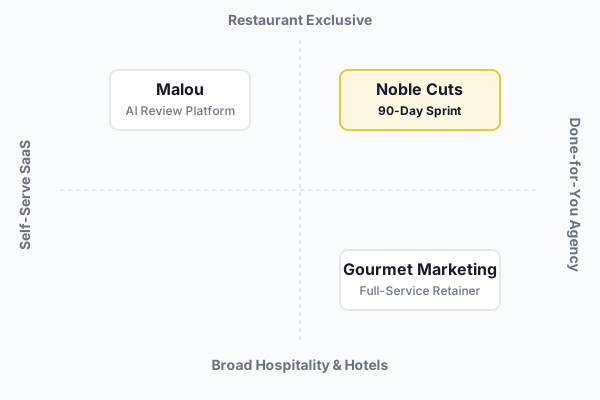
How Gourmet Marketing and Malou Compare
Core Features
Gourmet Marketing delivers done-for-you marketing across every major digital channel. Their team handles social media photography, content creation and scheduling, paid media campaigns, SEO strategy and implementation, influencer outreach, reputation monitoring, and website design. The agency model means the client is largely removed from day-to-day execution - the Gourmet Marketing team is, in effect, an outsourced marketing department. For a restaurant group that needs all of this and wants one vendor to own the relationship, that breadth is a genuine advantage.
Malou focuses specifically on the local digital presence - Google Business Profile, reviews, listings, and local social content - but automates it with AI at a depth and speed no human agency can match at scale. The platform's standout capability is AI-powered review management: it analyzes incoming reviews across all locations and auto-generates contextually appropriate responses, a task that becomes a real operational drain at 20+ locations. Malou also integrates directly with delivery aggregators and listing sites, centralizing what is often fragmented across multiple logins and platforms.
Bottom line: Gourmet Marketing wins when a group needs multi-channel strategy and execution across branding, paid, and content. Malou wins when the priority is local search presence, review management, and listings accuracy at scale - done autonomously without agency overhead.
Pricing
| Tier | Gourmet Marketing | Malou |
|---|---|---|
| Free | No free tier | No free tier |
| Starter | Custom quote | Not publicly listed |
| Business | Custom quote | Not publicly listed |
| Enterprise | Custom quote | Custom quote |
Pricing as of mid-2025. Check each product's pricing page for current rates.
Neither Gourmet Marketing nor Malou publicly discloses pricing, which makes direct comparison difficult for operators trying to budget. Gourmet Marketing's full-service agency model is almost certainly the higher absolute spend - full-service agencies managing SEO, paid, social, and design for a multi-location group routinely price into four to five figures per month. The trade-off is that the restaurant's team does very little: the agency absorbs the work.
Malou's SaaS model implies a per-location subscription structure, which is common for restaurant-focused platforms. A group with 10 locations would likely pay on a per-seat or per-location basis, meaning costs scale with portfolio size. That structure is predictable and transparent once quoted, but it also requires the internal team to actually use the platform daily - which adds a hidden cost in staff time that doesn't show up in the subscription price.
Ease of Use & Onboarding
Gourmet Marketing's agency model removes onboarding friction from the restaurant's side - the operator engages, hands off, and the agency team runs. The initial ramp-up involves agreeing on strategy, brand voice, and channel priorities, but after that the client's day-to-day involvement is minimal. For operators already stretched thin, that handoff model works because there's nothing to learn and nothing to maintain.
Malou is designed to be operator-friendly, and the platform's SaaS nature means it can be accessed from any device, with a centralized dashboard for all locations. That said, internal adoption is a real consideration. Someone on the restaurant's team needs to learn the platform, maintain discipline in using it, and ensure the AI-generated outputs are reviewed and approved before publishing. For groups with a dedicated marketing coordinator, that's manageable. For groups where the operator is also the marketer, the daily platform discipline can be harder to sustain.
Integrations & Ecosystem
Gourmet Marketing integrates with HubSpot for CRM and process streamlining, and its service delivery touches Google, major social platforms, and review sites as part of standard SEO and reputation management scope. Because Gourmet Marketing is an agency rather than a platform, "integrations" in the traditional software sense don't fully apply - the agency team manages access to the relevant platforms on the client's behalf.
Malou's integration depth is a genuine product strength. The platform connects directly with Google Business Profile, major social channels, listing aggregators, and delivery platforms like Uber Eats and Deliveroo. That cross-platform centralization means a change made in Malou can propagate across multiple directories simultaneously - a real efficiency gain for groups managing NAP (name, address, phone) consistency across 20+ locations and a dozen listing sites.
AI Capabilities
Gourmet Marketing incorporates data-driven strategy into its service delivery - analytics, performance reporting, and competitive intelligence - but AI-powered automation is not a stated core differentiator of the agency's model.
Malou's AI is the product's central claim. Review response generation, content suggestions, local SEO recommendations, and automated posting are all AI-driven. For a restaurant group facing the operational math of 100 reviews per week across 15 locations, AI automation isn't a nice-to-have - it's the only realistic way to manage it without a full-time review specialist. Malou's platform is genuinely well-suited to that problem.
Which Should You Choose: Gourmet Marketing or Malou?
Choose Gourmet Marketing if:
- Your group manages both hotel properties and restaurant F&B, and you want one agency that understands both sides of the hospitality business
- You need a full-service partner covering paid media, website design, social content, influencer marketing, and SEO under one engagement
- You prefer a done-for-you model where your internal team is largely removed from marketing execution
- You're building or rebuilding a brand presence and need strategic direction alongside tactical execution
- Ongoing relationship continuity matters - you want an agency that adapts strategy month over month, not a fixed-duration program
Choose Malou if:
- Your group is restaurant-only and has an internal marketing person or team who can operate the platform daily
- You have 10+ locations and are drowning in review volume - AI-generated responses at scale are exactly the problem you need solved
- Listings consistency (NAP accuracy across Google, delivery apps, and directories) is a recurring operational pain
- Your marketing strategy is already defined and you need tooling to execute it at scale without growing headcount
- Your group spans France, the UK, or markets where Malou has established traction and local support
A Third Option Worth Knowing About: Noble Cuts
Neither option quite fits every restaurant group - and that gap is where Noble Cuts comes in. Noble Cuts is a restaurant-only local-visibility marketing agency - in operation since 2016 - that runs a single concentrated program called the Visibility Reset: a 90-day, done-for-you push that closes every gap in a restaurant group's Google presence across all locations.
Noble Cuts is different from both in one concrete way: it is restaurant-exclusive, not hotel-primary with restaurants as a secondary client type. That means the playbook is built for covers, seasonal swings, dinner rush, and direction requests - the operational language of restaurant groups, not hospitality in the abstract. Unlike Malou, Noble Cuts requires nothing from the client's team: no platform adoption, no daily discipline, no content generation. The program repurposes social content the group already produces and turns it into automated local content - zero extra work for the operator. Proof points from across their client roster (The Dead Rabbit, Hill Country, Sunday Hospitality Group, High Street Hospitality, Hotel Chelsea, and others) average +42% Google Impressions, +61% GBP Views, +52% Menu Views, and +46% Direction Requests across the 90-day window.
Noble Cuts fits if your group has 3–20 locations, inconsistent or unoptimized Google Business Profiles, limited marketing bandwidth, and you want a defined engagement with a concrete before/after report rather than an open-ended retainer or a platform you'll need to staff. The program comes with a full money-back guarantee at 90 days - if results don't materialize, you get a full refund. Very few agencies offer anything close to that.
Where Noble Cuts is not the right fit: if your group needs ongoing marketing management beyond local search (paid media, brand campaigns, influencer programs), or if your 90-day visibility gaps are already closed and you need long-term platform tooling to maintain them at scale across 50+ locations.
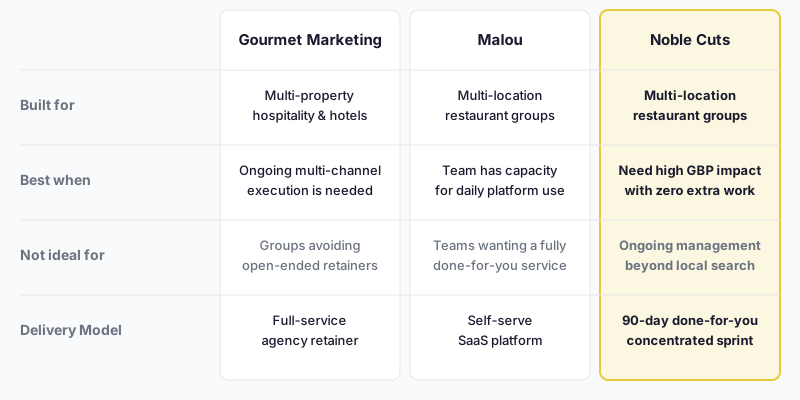
At-a-Glance: Gourmet Marketing, Malou, and Noble Cuts
| Gourmet Marketing | Malou | Noble Cuts | |
|---|---|---|---|
| Core purpose | Full-service hospitality marketing agency | AI-powered local marketing platform for restaurants | 90-day Google visibility sprint for restaurant groups |
| Service type | Done-for-you agency | Self-service SaaS with support | Done-for-you agency |
| Industry focus | Hotels primary, restaurants secondary | Restaurant-exclusive | Restaurant-exclusive since 2016 |
| Pricing model | Custom agency retainer | Per-location SaaS subscription | One-time 90-day program |
| Starting price | Not publicly listed | Not publicly listed | Quoted via free strategy call |
| Free tier | No | No | Free 20-min strategy call |
| AI features | Data-driven strategy and analytics | AI review responses, content suggestions, automated posting | Automated local content from existing social |
| Ease of use | Agency manages; minimal client workload | Requires internal platform adoption | Zero extra work from client team |
| Integration depth | Google, social, HubSpot | Google, social, listings, delivery aggregators | Google Business Profile, on-page SEO |
| Risk reversal | Not disclosed | No published guarantee | Full money-back guarantee at 90 days |
| Best for | Hotel + restaurant hospitality groups needing full-service ongoing marketing | Restaurant groups with internal team capacity and 10+ locations needing automation at scale | Multi-location restaurant groups with GBP gaps and zero bandwidth for extra marketing work |
Pricing as of mid-2025.
Next Steps
The split here is pretty clean. Gourmet Marketing makes sense if you need ongoing, full-service hospitality marketing across channels. Malou makes sense if you have an internal team ready to use a platform daily and want AI-powered automation at scale. If you're in the narrower group that fits Noble Cuts - a restaurant group with 3–20 locations, inconsistent Google presence, and no bandwidth to run another platform - the lowest-friction next step is a free 20-minute strategy call at noblecuts.com, which includes a no-obligation audit of your current local search gaps. Otherwise, Gourmet Marketing's site and Malou's platform both offer direct inquiry forms to get a quote.
Frequently Asked Questions
What is Gourmet Marketing's core service offering?
Gourmet Marketing is a full-service hospitality marketing agency delivering SEO, paid media, website design, social media management, reputation management, and influencer marketing primarily to hotels and resorts across North America, with restaurant groups as a secondary client type. The agency positions itself as an outsourced marketing department, handling all channel strategy and execution on behalf of the client's team. For hospitality groups that need multi-channel consistency and prefer done-for-you services, Gourmet Marketing provides continuity across branding, paid, and content that no single-purpose platform can.
What is Malou and how does it work?
Malou is an AI-powered SaaS platform built exclusively for multi-location restaurant groups, launched in 2021 and backed by over $10M in Series A funding. The platform centralizes Google Business Profile optimization, AI-generated review responses, listings management, and social content tools across all locations, automating the operational work that becomes unmanageable at 10+ locations without platform tooling. Malou is designed for restaurant groups with strategy already in place but needing operational execution tooling to scale without growing headcount.
How does Gourmet Marketing differ from Malou?
Gourmet Marketing is a done-for-you full-service agency that removes marketing work from the client's team entirely, while Malou is a self-service SaaS platform that requires internal adoption and daily discipline from the restaurant's team. Gourmet Marketing spans multiple marketing channels including paid, social, web design, and influencer work, whereas Malou focuses specifically on local search presence, review management, and listings at scale. The trade-off is clear: hire an agency to manage everything, or adopt platform tooling and manage it yourself.
What does Gourmet Marketing charge, and is pricing transparent?
Gourmet Marketing does not publicly disclose pricing and custom-quotes every engagement, consistent with the full-service agency model where scope varies significantly by client and property size. Full-service agencies managing SEO, paid, social, and design for multi-location groups typically cost four to five figures per month as of mid-2025. The lack of public pricing reflects the agency's approach of building custom packages rather than fixed-tier offerings.
What does Malou cost, and how is pricing structured?
Malou does not publicly list pricing and custom-quotes engagements, though the SaaS model implies per-location subscription tiers that scale with portfolio size. A restaurant group with 10 locations would likely pay based on per-seat or per-location pricing, creating predictability once quoted. The SaaS structure is transparent and scalable, but adds a hidden cost in staff time required to actually use the platform daily, which is not reflected in the subscription price.
Which platform is better for managing reviews at scale?
Malou is specifically built for review management at scale, with AI-generated response suggestions that can run across 100+ locations automatically-a task that becomes a real operational drain at 20+ locations without automation. Gourmet Marketing includes reputation management as part of its full-service offering, but relies on human team attention rather than AI automation. For restaurant groups facing dozens or hundreds of reviews per week, Malou's AI automation is the only realistic way to manage response volume without a dedicated specialist.
Is Gourmet Marketing a good fit for restaurant-only groups?
Gourmet Marketing is hotel-primary with restaurants as a secondary client type, making it a better fit for multi-property hospitality groups that run both hotel and restaurant F&B operations together. If your group is restaurant-exclusive and doesn't need paid media, web design, or influencer marketing-only local search and reviews-then a platform like Malou or a restaurant-specialized agency may be more focused for your needs. Gourmet Marketing's breadth is an advantage for complex hospitality portfolios, but it is not a restaurant-exclusive specialist.
Why is internal adoption a challenge with platform-based solutions like Malou?
Malou requires someone on the restaurant's team to learn the platform, maintain daily discipline using it, and review AI-generated outputs before publishing-a real operational burden for groups where the operator is already stretched thin. Unlike a done-for-you agency like Gourmet Marketing, which absorbs all the work, platforms demand internal staff allocation and sustained engagement to realize value. For restaurant groups with a dedicated marketing coordinator, that discipline is manageable; for owner-operators also running the marketing function, daily platform maintenance can be harder to sustain.
How do Gourmet Marketing and Malou differ in their integration approach?
Gourmet Marketing integrates with HubSpot for CRM and process management but operates as an agency managing access to multiple platforms on the client's behalf, so traditional software integrations don't fully apply. Malou's strength is deep cross-platform integration-directly connecting with Google Business Profile, social channels, listing aggregators, and delivery platforms like Uber Eats so that changes propagate simultaneously across directories. For restaurant groups managing NAP consistency across 20+ locations and multiple listing sites, Malou's centralized integration is a genuine operational advantage.
What does Gourmet Marketing mean by operating as an 'in-house sales team'?
Gourmet Marketing positions itself as an outsourced marketing department that operates with the strategic continuity and accountability of an internal team, rather than as a transactional vendor executing discrete campaigns. This model implies ongoing relationship management, month-over-month strategic adaptation, and shared responsibility for results-the agency is effectively an extension of the hospitality group's leadership. For groups seeking agency continuity across branding, paid media, and content, that partnership framing provides consistency; it also means the engagement is typically structured as an open-ended retainer rather than a fixed project.
Is Malou better for larger or smaller restaurant groups?
Malou is explicitly built for multi-location restaurant groups with 10 to 100+ locations, where the operational math of review management, listings consistency, and local content distribution across many properties becomes unmanageable without platform automation. A single-location restaurant or small 3-location group would likely benefit more from focused local SEO work or a specialized agency, while a 50+ location chain would find Malou's automation cost-effective versus hiring dedicated marketing staff. The platform's value proposition is strongest at the point where human operational scaling becomes prohibitively expensive.
What is the difference between done-for-you and self-service models for restaurant marketing?
A done-for-you model (like Gourmet Marketing) removes marketing execution entirely from the restaurant's team-the agency handles strategy, content, campaigns, and reporting, requiring minimal internal involvement beyond approvals. A self-service platform model (like Malou) provides tooling and automation but places the burden of daily use, content generation, and review discipline on the restaurant's internal team. The trade-off is straightforward: pay more for an agency to eliminate internal workload, or pay less for a platform and absorb the staff time required to operate it.
Which option provides better transparency and risk reversal?
Neither Gourmet Marketing nor Malou publicly discloses pricing or offers published guarantees as part of their standard model, leaving restaurant operators to quote custom terms without upfront cost visibility or risk protection. Gourmet Marketing's agency retainer model implies ongoing commitment and adaptation, while Malou's SaaS structure offers predictable per-location pricing once quoted, but neither shifts financial risk to the vendor if results don't materialize. For groups seeking upfront cost transparency and risk reversal, this is a gap that neither traditional agency nor platform option fully addresses.
When should a restaurant group choose Malou over Gourmet Marketing?
Malou is the better choice if your restaurant group is exclusively restaurant-focused, has an internal marketing person ready to operate the platform daily, manages 10+ locations, and is drowning in review volume and listings inconsistencies that require AI-powered automation to solve cost-effectively. Your marketing strategy should already be defined, and your priority is operational execution at scale rather than strategic direction or multi-channel campaigns. If your group spans France, the UK, or regions where Malou has established local support, that geographic fit also improves the value proposition.
When should a restaurant group choose Gourmet Marketing over Malou?
Gourmet Marketing is the better choice if your hospitality group manages both hotel properties and restaurant F&B operations together, needs a full-service partner covering paid media, website design, branding, and influencer marketing alongside local SEO, or prefers a done-for-you model where your team is largely removed from execution. You should value ongoing relationship continuity and month-over-month strategic adaptation over a fixed-duration program or self-service platform, and you want one agency managing cohesive strategy across all channels. If your group is building or rebuilding brand presence, Gourmet Marketing's breadth provides the strategic continuity a platform cannot match.