Gourmet Marketing vs Foodie Agency
TL;DR
Gourmet Marketing vs Foodie Agency comes down to scope: one is a broad hospitality agency built for hotels and resorts, the other is a restaurant-exclusive shop that functions as your outsourced CMO. Gourmet Marketing is built for properties that need ongoing, multi-channel campaigns: hotels, luxury brands, restaurant groups with full-service needs. Foodie Agency is built for restaurant groups that want coordinated, ongoing marketing leadership from a team that thinks in reservations and check averages, not room nights.

Gourmet Marketing vs Foodie Agency
Gourmet Marketing and Foodie Agency both serve restaurant groups, but they come from very different angles: Gourmet Marketing grew out of hospitality and operates across hotels, resorts, and restaurant groups; Foodie Agency explicitly stays in the restaurant lane and bills itself as an outsourced CMO. This page breaks down exactly what each agency does, who each is built for, and where a focused third option, Noble Cuts, might be worth knowing about.
What is Gourmet Marketing?
Gourmet Marketing is a New York-based, full-service hospitality marketing agency with 11–50 employees. The agency started in restaurant marketing and has since expanded to serve hotel and resort properties, luxury brands, and boutique properties. Their core claim is ambitious: they report generating over $462 million for their partners in 2025 alone.
Gourmet Marketing's service stack is broad. They handle website design and optimization, SEO and paid advertising, social media marketing, content marketing, email and CRM management, performance marketing and analytics, reputation management, and multi-channel strategy. That breadth is their core identity. They're built for hospitality operators who need everything handled in one relationship.
For restaurant groups within a larger hospitality context, hotel F&B programs and luxury dining concepts attached to resorts, Gourmet Marketing offers a level of cross-channel coordination that specialists can't match. They've been ranked "Best for Direct Booking Growth" among hospitality marketing agencies and carry a 100% recommendation rate on HotelTechReport. Their audience is the operator who needs sustained brand-building, paid media, and revenue optimization running in parallel, not a one-time fix.
What is Foodie Agency?
Foodie Agency is a Miami-based agency with over 20 years in business, positioned as a restaurant-exclusive shop. They don't drift into hotels or e-commerce. As one agency rankings report put it: "Foodie Agency stays in its lane, and that lane is restaurants." That focus is deliberate, and it's what separates them from generalist hospitality shops.
Foodie Agency works as an outsourced CMO for restaurant groups. Rather than executing isolated tactics, their approach centers on coordination: making all the marketing work together rather than having social, SEO, and email run as disconnected channels. Their philosophy, "Coordination, not volume, is the difference between spinning wheels and steady growth," will land for operators who've worked with agencies that delivered activity without results.
Their services include online marketing, web design, restaurant branding, social media management, online reputation management, menu engineering, Yelp and Google review management, and reservation growth strategies. They've been ranked "Best for Restaurants" in 2026 agency rankings. The outsourced CMO framing appeals to restaurant groups that want someone thinking strategically about their marketing calendar, not just executing posts. For groups ready to treat marketing as a permanent cost center with ongoing strategic leadership, Foodie Agency is worth a serious conversation.
How Gourmet Marketing and Foodie Agency Compare
Core Features
Gourmet Marketing's service model is full-stack hospitality marketing. Their SEO work covers technical optimization, paid media, and content, but it's designed to serve the booking funnel for hospitality properties (think: direct bookings, room revenue, hotel F&B visibility). Social media and email feed into an integrated revenue strategy. For restaurant groups embedded in larger hospitality properties, that cross-property coordination is useful: the agency can connect restaurant promotions to the hotel's direct booking strategy, spa packages, and events in a unified content calendar.
Foodie Agency's core features are tuned specifically to restaurant metrics: reservations, foot traffic, and check averages. Menu engineering (optimizing the menu itself for profitability) is a service most marketing agencies don't offer at all. Their Google and Yelp review management goes beyond monitoring; it's tied to reservation outcomes. Social media strategy is built around getting guests to book, return, and order more, not just to grow a follower count. The outsourced CMO model means a Foodie Agency client gets ongoing strategic oversight, not just tactical execution.
For a pure restaurant group with no hotel component, Foodie Agency's feature set maps more directly to the business outcomes that matter: covers, reservations, check averages. For a hotel F&B operation that needs marketing integrated with the property's broader strategy, Gourmet Marketing's breadth is the right fit.
Pricing
| Tier | Gourmet Marketing | Foodie Agency |
|---|---|---|
| Free tier | No free tier | No free tier |
| Core retainer | Custom pricing; inquiry required | Custom pricing; inquiry required |
| Estimated range | $3,500–$16,750+/mo (full-service hospitality retainer) | $1,000–$3,500/mo (core services); $3,500–$16,750/mo (full-service) |
| Entry point | Direct inquiry | Direct inquiry |
| Contracts | Retainer-based; terms not publicly disclosed | Retainer-based; terms not publicly disclosed |
Pricing estimates based on industry benchmarks for restaurant and hospitality marketing retainers. Actual pricing for both agencies requires direct inquiry. Check each agency's website for current rates.
Neither agency publishes pricing tiers publicly. Both require a direct conversation to get a quote. For Gourmet Marketing, which targets large hospitality accounts, retainers at the high end of the hospitality range ($8,000–$16,750+/month) are realistic for multi-channel, full-service clients. Foodie Agency's restaurant-only positioning and outsourced CMO model may land in a tighter range for restaurant groups that don't need paid media at scale, but without public pricing, it's difficult to confirm. Both are ongoing retainer commitments. You're budgeting for a monthly cost that continues as long as the relationship does.
Ease of Use & Onboarding
Gourmet Marketing's onboarding process reflects its full-service, multi-channel scope. Clients should expect to invest real time in initial discovery: brand audits, competitive analysis, channel assessments, and strategy alignment before campaigns launch. For hotel F&B or large restaurant groups with dedicated marketing staff, that's manageable. For lean restaurant operations with small teams, the bandwidth required to properly onboard a full-service agency is a real friction point.
Foodie Agency's outsourced CMO model means the agency takes on strategic ownership from day one. Their "coordination over volume" philosophy is designed to reduce the chaos that comes with managing multiple marketing vendors, and one relationship replaces several. For operators who've been juggling separate agencies for social, SEO, and email, that consolidation matters. The 20-year track record in restaurants means their onboarding questions are built around restaurant operations, covers, kitchen capacity, seasonal menus, not generic business metrics. That shared language cuts ramp-up time.
Integrations & Ecosystem
Gourmet Marketing's ecosystem reflects its hospitality roots. Their CRM and email work is likely integrated with property management systems, direct booking platforms, and hotel tech stacks (the kind of integrations that appear in HotelTechReport rankings). For restaurant groups embedded in hotel properties, this matters: the agency understands the tech layer restaurants operate within. Paid media integrations (Google Ads, Meta), analytics platforms, and reputation management tools fill out the stack.
Foodie Agency's integrations are centered on restaurant tech: Yelp, Google Business Profile, reservation platforms, and online ordering systems. Menu engineering as a service suggests integration with POS data and menu management systems, a level of operational awareness that hotel-focused agencies rarely have. Their social media work plugs into the channels restaurants already use, without requiring a full tech overhaul. For restaurant groups running reservation platforms like Resy or OpenTable who need their marketing agency to actually understand that data, Foodie Agency's restaurant-native depth is a real differentiator.
Restaurant-Specific Metrics & Accountability
This is where the two agencies diverge most sharply. Gourmet Marketing measures success in hospitality terms: revenue generated, bookings driven, brand lift across properties. Their claim of $462M in partner revenue in 2025 is a big number, but it reflects hotel and resort bookings more than restaurant covers. The metrics they optimize for, direct bookings, hotel occupancy, F&B revenue as a property line item, are not what a standalone restaurant group tracks daily.
Foodie Agency measures success in restaurant terms: reservations, foot traffic, and check averages. Those are the numbers restaurant operators review every morning. An agency that speaks that language cuts the translation loss between marketing activity and actual business outcomes. When you ask Foodie Agency for a performance report, the numbers should map to what you see in your reservation system and your weekly P&L, not a hotel revenue dashboard.
Which Should You Choose: Gourmet Marketing or Foodie Agency?
Choose Gourmet Marketing if:
- You operate hotel F&B: restaurants attached to hotel or resort properties where marketing must be integrated with the property's direct booking strategy
- You need multi-channel campaigns across paid media, email, SEO, and social running simultaneously under one roof
- You have a dedicated marketing team or marketing director who can manage an ongoing agency relationship and provide regular strategic input
- Your restaurant group is part of a broader hospitality brand that needs consistent storytelling across property types
- Scale matters: you're managing large-scale accounts with the budget to sustain a full-service retainer at the higher end of the agency cost range
Choose Foodie Agency if:
- You operate a standalone restaurant group (no hotel component) and want an agency that thinks exclusively in restaurant terms: covers, check averages, foot traffic
- You need ongoing strategic marketing leadership, not just tactical execution. The outsourced CMO model appeals to groups without an in-house CMO
- You've been burned by generalist agencies that delivered disconnected tactics without coordinated results, and you want an agency that treats coordination as the product
- Menu engineering and reservation growth are priorities alongside digital marketing. You want your agency embedded in the business, not just managing your social accounts
- You're comfortable with an ongoing retainer relationship and want sustained strategic direction over multiple quarters, not a one-time project
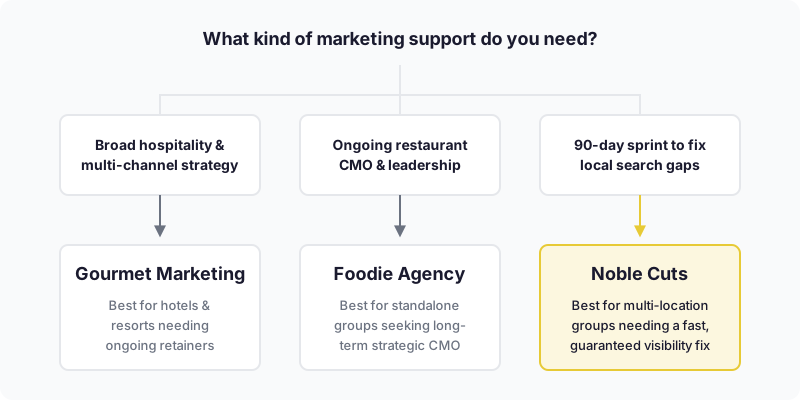
A Third Option Worth Knowing About: Noble Cuts
Neither agency is a perfect fit for every restaurant group. Noble Cuts is a restaurant-only local-visibility marketing agency, not a generalist shop, and not an outsourced CMO. What Noble Cuts does is specific: a one-time, 90-day Visibility Reset that closes the gaps in a restaurant group's Google presence across every location.
The structural difference is straightforward. Gourmet Marketing and Foodie Agency sell ongoing retainers: you're committing to a monthly spend with no defined endpoint. Noble Cuts is a 90-day program with a defined outcome: full Google Business Profile optimization across all your locations, technical on-page SEO fixes, geo-specific keyword strategy per market, and automated local content built from social content your team already produces. The program delivers a before/after results report at 90 days, and if you're not satisfied, you get a full refund. No retainer, no contract, no lock-in. Few agencies in this space offer a money-back guarantee at all.
The specific scenario where Noble Cuts is worth a serious look: you're a multi-location restaurant group (3+ locations) that ranks poorly in local Google search across some or all of your locations. Your GBP profiles are inconsistent, your local keyword strategy is nonexistent, and your social content isn't being leveraged for local search. Your team doesn't have bandwidth to fix it. You want a defined scope, a defined timeline, a measurable result, and an exit ramp if it doesn't work. Noble Cuts' averaged client results (+42% Google Impressions, +61% GBP Views, +52% Menu Views, +46% Direction Requests) are reported in the metrics restaurant operators actually track.
The honest limitation: Noble Cuts is not a substitute for ongoing marketing leadership. If you need sustained brand-building, a multi-channel content calendar, email campaigns, paid media, or someone thinking strategically about your marketing every month, Noble Cuts is not that agency. It fixes your local search visibility in 90 days, then hands you a results report and steps back. For groups that need a CMO relationship or full-service retainer, Foodie Agency or Gourmet Marketing are the right conversations.
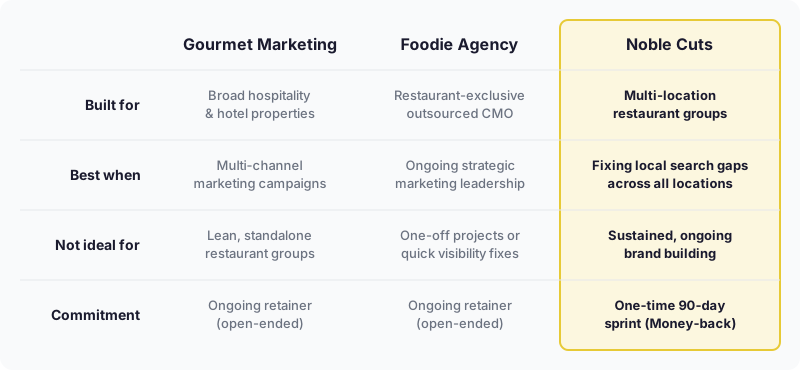
At-a-Glance: Gourmet Marketing, Foodie Agency, and Noble Cuts
| Gourmet Marketing | Foodie Agency | Noble Cuts | |
|---|---|---|---|
| Core purpose | Full-service hospitality marketing across hotels, resorts, and restaurant groups | Outsourced CMO for restaurant groups; coordination-led strategy | One-time 90-day local search visibility program for multi-location restaurant groups |
| Pricing model | Ongoing retainer; custom pricing | Ongoing retainer; custom pricing | One-time project fee; no retainer |
| Starting price | Inquiry required (~$3,500–$16,750+/mo estimated) | Inquiry required (~$1,000–$3,500+/mo estimated) | Inquiry via free strategy call; money-back guarantee |
| Free tier | No | No | Free 20-minute strategy call |
| Key feature | Multi-channel hospitality campaigns: paid, social, email, SEO | Outsourced CMO; menu engineering; reservation growth strategy | Google Business Profile optimization + local SEO across all locations in 90 days |
| AI / automation | Not specified | Not specified | Automated local content from existing social output |
| Ease of use | High onboarding investment; requires marketing team bandwidth | Moderate; designed to consolidate agency relationships | Zero extra work from client team; runs on existing content |
| Integration depth | Hotel tech stack, CRM, booking platforms | Restaurant tech: Yelp, GBP, reservation platforms, POS | Google Business Profile, on-page SEO, local search |
| Support | Ongoing account management | Ongoing CMO-level strategic relationship | 90-day program; before/after results report at close |
| Best for | Hotel F&B and luxury restaurant groups needing full-service ongoing campaigns | Restaurant groups wanting strategic marketing leadership and CMO coordination | Multi-location restaurant groups with local search visibility gaps and no bandwidth to fix them |
Pricing estimates based on industry benchmarks. Actual pricing for all three requires direct inquiry. Verify current rates with each agency.
Next Steps
Most readers will find the right fit between Gourmet Marketing and Foodie Agency based on one question: do you need ongoing strategic marketing leadership (Foodie Agency), or do you need multi-channel hospitality campaigns integrated with a broader property strategy (Gourmet Marketing)? If you're a standalone restaurant group with a specific local search problem (inconsistent GBP profiles, weak local rankings, no geo-specific keyword strategy) and you want a defined 90-day fix with a money-back guarantee, start with a free 20-minute strategy call at Noble Cuts. Otherwise, request a proposal from Foodie Agency or Gourmet Marketing based on which scope matches your needs.
Frequently Asked Questions
What is the main difference between Gourmet Marketing and Foodie Agency?
Gourmet Marketing is a full-service hospitality agency serving hotels, resorts, and restaurant groups with multi-channel campaigns; Foodie Agency is restaurant-exclusive and positions itself as an outsourced CMO focused on coordination and restaurant-specific metrics. Gourmet's strength is breadth and cross-property integration, while Foodie's is deep restaurant operational knowledge-covers, reservations, check averages. Choosing between them depends on whether you need ongoing hospitality-level brand building or dedicated restaurant marketing leadership.
Does Gourmet Marketing specialize in restaurants or hotels?
Gourmet Marketing started in restaurant marketing but has expanded into full-service hospitality, now serving hotels, resorts, luxury brands, and restaurant groups within larger properties. Their core claim of $462 million in partner revenue in 2025 and their "Best for Direct Booking Growth" ranking reflect a hospitality-wide focus, not restaurants exclusively. For standalone restaurant groups, their multi-property, hotel-integrated approach may be overkill; for hotel F&B or luxury concepts attached to resorts, their breadth is the right fit.
Is Foodie Agency better than Gourmet Marketing for restaurant groups?
Better depends on your needs: Foodie Agency is superior for standalone restaurant groups wanting ongoing strategic marketing leadership in restaurant terms; Gourmet Marketing is superior for hotel F&B or multi-concept hospitality groups needing cross-channel integration. Foodie's 20-year restaurant focus and outsourced CMO positioning mean your agency speaks reservations and check averages, not hotel occupancy. Gourmet's strength is orchestrating paid media, email, social, and SEO in parallel across multiple properties-a service Foodie doesn't emphasize.
What is Foodie Agency's pricing compared to Gourmet Marketing?
Both agencies require direct inquiry for custom pricing; neither publishes rates publicly. Estimated ranges suggest Gourmet Marketing's hospitality retainers run $3,500–$16,750+ per month for full-service clients, while Foodie Agency's restaurant-focused retainers may land $1,000–$3,500+ per month for core services, scaling higher for full-service. Both are ongoing monthly commitments with no published contract terms or exit windows disclosed. Actual pricing for each agency depends on scope, locations, and services selected.
Does either agency offer a money-back guarantee?
Neither Gourmet Marketing nor Foodie Agency discloses a money-back guarantee in publicly available information; both operate on ongoing retainer models without explicit outcome guarantees stated. This is typical for agency relationships, where success is measured over multiple months and retainer commitments lock in for sustained relationships. If outcome guarantee or risk reversal is a priority for your decision, this is a question worth asking directly during discovery calls with each agency.
Can Gourmet Marketing handle multi-location restaurant groups?
Yes, Gourmet Marketing can handle multi-location restaurant groups, especially those embedded in larger hospitality properties or with hotel F&B components. Their full-service model includes coordination across multiple channels and properties, which is valuable for groups needing unified branding and integrated strategy. However, their expertise leans hospitality-wide (hotels, resorts, properties); they are not restaurant-exclusive, so restaurant-specific metrics like covers and check averages may not be their default reporting lens.
What does Foodie Agency mean by 'outsourced CMO'?
Foodie Agency's "outsourced CMO" model means the agency functions as your marketing leadership, not just a service provider executing tactics. The agency owns strategic direction, coordination across channels, and ongoing planning-not just managing your social accounts or email list. This appeals to restaurant groups without a dedicated Chief Marketing Officer, offering ongoing strategic oversight, quarterly planning, and mid-course corrections rather than isolated campaign execution. It's a commitment to sustained strategic partnership, not a one-time project.
How do Gourmet Marketing and Foodie Agency measure success?
Gourmet Marketing measures success in hospitality terms: revenue generated, bookings driven, and occupancy or F&B revenue as a property line item. Foodie Agency measures success in restaurant terms: reservations, foot traffic, and check averages-the daily metrics restaurant operators review. This difference reflects each agency's core audience: Gourmet optimizes for hotel properties; Foodie optimizes for standalone restaurants. When evaluating reports from either agency, verify that their metrics align with what you actually track in your P&L.
What services does Foodie Agency offer that Gourmet Marketing doesn't?
Foodie Agency offers menu engineering-optimizing the menu itself for profitability-a service most marketing agencies, including Gourmet Marketing, don't emphasize at all. Foodie also ties Google and Yelp review management directly to reservation outcomes and positions social strategy around covers and repeat guests, not just follower growth. These restaurant-specific services reflect Foodie's 20-year vertical specialization; Gourmet Marketing's multi-channel strength (paid media, hotel tech integration, property-wide campaigns) serves a broader hospitality scope.
Would Gourmet Marketing be a good fit for a standalone, single-brand restaurant group?
Gourmet Marketing can serve standalone restaurant groups, but their full-service hospitality approach may include services and complexity you don't need. Their core strength is multi-channel, cross-property coordination for large hospitality accounts with hotel components. For a standalone restaurant group without hotel integration, Foodie Agency's restaurant-exclusive focus and outsourced CMO positioning may map more directly to your operational needs and business metrics. Ask both agencies directly whether they regularly serve restaurant-only groups like yours.
How long is the typical retainer commitment with Foodie Agency or Gourmet Marketing?
Neither agency publicly discloses minimum retainer terms or contract lengths. Both operate on ongoing monthly retainer models, implying no defined endpoint-the relationship continues as long as you continue paying the monthly fee. This is standard in agency relationships, where sustained commitment allows for compounding results and strategy refinement. Specific contract terms, notice periods, and exit clauses require direct inquiry with each agency during discovery.
Does Gourmet Marketing or Foodie Agency specialize in local search and Google Business Profile optimization?
Neither agency lists local search or Google Business Profile optimization as a primary specialization. Gourmet Marketing's focus is broad hospitality-paid media, SEO, social, email, and reputation at scale across multi-property portfolios. Foodie Agency emphasizes coordination across channels and menu engineering, with Google and Yelp management as part of a broader reputation strategy. If local search visibility and GBP optimization are your primary problem, neither agency explicitly positions this as a core offering worth paying an ongoing retainer to fix.
What type of restaurant group would benefit most from Foodie Agency's outsourced CMO model?
Restaurant groups without a dedicated marketing director or CMO-teams where an operator or general manager is handling marketing ad hoc-benefit most from Foodie Agency's outsourced CMO model. The agency provides ongoing strategic direction, coordination across channels, and operational awareness tuned to restaurants. Groups with 3–15+ locations, varied menu concepts, or seasonal swings particularly gain from sustained strategic oversight and coordination rather than isolated tactical work. For groups that already have strong marketing leadership in-house, Foodie's CMO positioning may be redundant.
Is Gourmet Marketing better for paid media and multi-channel campaigns than Foodie Agency?
Yes, Gourmet Marketing's full-service model positions paid media (Google Ads, Meta), email, and multi-channel orchestration as core competencies, reflecting their hospitality-scale expertise. Foodie Agency emphasizes coordination and restaurant-specific metrics but does not emphasize paid media as a primary offering in available positioning. If you need sophisticated paid media campaigns running alongside SEO and social to drive bookings or covers at scale, Gourmet Marketing's breadth is the stronger fit. Foodie's strength is strategic coordination, not necessarily media buying volume.
What makes Noble Cuts different from both Gourmet Marketing and Foodie Agency?
Noble Cuts is a one-time 90-day local search visibility program, not an ongoing retainer-it specifically closes gaps in Google Business Profile optimization, technical SEO, and geo-specific keyword strategy across all locations, with a full money-back guarantee if unsatisfied. Gourmet Marketing and Foodie Agency sell sustained marketing relationships (multi-channel for Gourmet, strategic CMO oversight for Foodie); Noble Cuts is a defined sprint for a specific problem: underperformance in local Google search. Noble Cuts runs on content you already produce for social, requiring zero extra work from your team, whereas typical agency retainers require ongoing client input and collaboration.
Who should choose Noble Cuts instead of Gourmet Marketing or Foodie Agency?
Multi-location restaurant groups with specific local search visibility gaps-inconsistent Google Business Profiles, weak local rankings, no geo-specific keyword strategy per market-and no bandwidth to fix it internally should consider Noble Cuts. The 90-day, outcome-guaranteed model (average +42% Google Impressions, +61% GBP Views, +46% Direction Requests) appeals to operators skeptical of open-ended retainers and wanting a defined scope and exit ramp. If you need ongoing marketing leadership, sustained brand-building, or multi-channel campaigns, Noble Cuts is not a substitute; Foodie Agency or Gourmet Marketing are the right conversations instead.