Foodie Agency vs Malou
TL;DR

Foodie Agency vs Malou is really an agency-vs-software question: do you want a team managing everything for you, or a platform your own team runs? Foodie Agency is built for restaurants that want done-for-you branding, paid media, social, and reputation work over the long term. Malou is built for groups with internal marketing bandwidth that want AI-powered self-service tools, real-time dashboards, and continuous local SEO optimization at scale. Choose Foodie if you want done-for-you creative and paid media; choose Malou if you want an always-on platform your team controls.
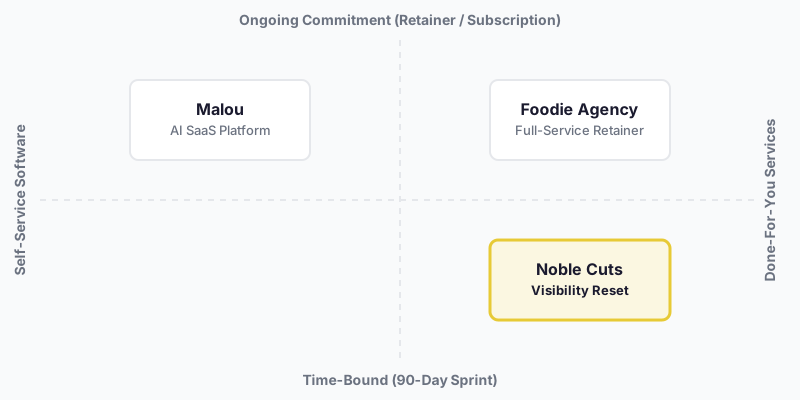
Foodie Agency vs Malou
Foodie Agency is a full-service restaurant marketing agency founded in Miami in 2002, offering branding, social media management, web design, paid media, and reputation management. Malou is an AI-powered SaaS platform founded in Paris in 2019, designed to help restaurant groups manage local SEO, Google Business Profiles, reviews, and social content from a centralized dashboard. This page breaks down how they compare on features, pricing, ease of use, and integrations - and which one fits which type of operator.
What is Foodie Agency?
Foodie Agency is a Miami-based, full-service restaurant marketing firm with more than 20 years in the industry. Founded in 2002, it works as a long-term strategic partner for restaurant and hospitality brands that need comprehensive marketing support: brand identity, web design, paid digital advertising, and local listing management. It is a human-driven, done-for-you agency model.
Foodie Agency serves independent restaurants, multi-location groups, and regional chains, particularly in the Southeast Florida and Caribbean corridor. Its clients come to it when they need a single partner to own their entire marketing presence: someone who understands the brand, manages social channels, runs paid campaigns on Google and Meta, and keeps Yelp, Google Business, and TripAdvisor listings current. The relationship is ongoing. Foodie builds institutional knowledge of a client's brand and compounds that over years, not months.
Foodie holds an A+ BBB rating and has been accredited since 2015. It uses Tubular Labs for influencer measurement, integrates with POS systems for loyalty and email campaigns, and produces custom digital menus and signage. For operators who want one agency covering strategy, creative, paid, and organic, Foodie is a genuine one-stop shop with over two decades of restaurant clients behind it.
What is Malou?
Malou is an AI-powered local visibility platform built specifically for the restaurant industry. Founded in 2019 and headquartered in Paris, Malou has grown to serve 3,500+ hospitality groups across 12 countries, with active expansion into the US market backed by $10.92 million in funding from investors including Bertrand Jelensperger (founder of The Fork) and Jim Texier (former Lightspeed CPO).
Malou targets restaurant groups with internal marketing capability - operators or agency teams who want a centralized software dashboard to manage Google Business Profile optimization, local keyword strategy, AI-powered review responses, and social media content generation across every location. It is a self-service platform, meaning the client's team configures it, trains on it, and drives results with Malou's tools rather than outsourcing the work to Malou staff.
Malou's AI generates review responses in the restaurant's brand voice, tracks keyword rankings and GBP performance in real time, and handles what the company calls Generative Engine Optimization (GEO) - optimizing for AI search as well as traditional Google Maps results. Case studies include Krispy Kreme France achieving +48% Google Maps impressions across 20 locations in 5 months, and Riviera Dining Group Miami reaching number one on Google Maps for competitive cuisine categories across 5 venues. For groups willing to operationalize a new platform, Malou's automation runs deep.
How Foodie Agency and Malou Compare
Core Features
Foodie Agency's feature set is broad by design. It offers branding and brand strategy, social media management, custom web design and development, paid media (PPC, Facebook and Instagram ads, local influencer campaigns), email and SMS marketing, POS integration for loyalty programs, and reputation management across Google Business, Yelp, and TripAdvisor. Foodie also produces custom food and drink menus and digital screen content - physical brand assets most SaaS platforms don't touch. Its service model is human-driven: a dedicated team that learns a restaurant's brand and executes across every channel. The breadth is Foodie's core pitch - one relationship, every channel, managed for you.
Malou's feature set is narrower and deeper within the local visibility lane. Core capabilities include Google Business Profile optimization across all locations, AI-powered keyword strategy and local SEO, automated review response generation (AI writes responses following brand voice guidelines), social media post scheduling and content generation, a unified multi-location dashboard, and GEO optimization for AI-powered search engines. Malou claims its platform saves restaurant groups 28 hours per month per location and helps maintain a 4.6+ average Google rating. The platform integrates with 50+ third-party tools and operates across 12 countries - a global footprint Foodie Agency doesn't match.
Bottom line: If a restaurant group needs branding, paid media, and full creative services, Foodie is the better fit - Malou doesn't do any of that. If the priority is AI-powered local SEO and review automation at scale, Malou is the more capable tool. These two products are not really competing for the same job.
Pricing
| Tier | Foodie Agency | Malou |
|---|---|---|
| Free | No free tier | No free tier |
| Starter | Custom quote required | Demo required; pricing not public |
| Business | Custom retainer package | Custom quote per location count |
| Enterprise | Custom | Custom |
Pricing as of mid-2025. Check Foodie Agency's pricing page and Malou's demo page for current rates.
Both Foodie Agency and Malou require a conversation before pricing is disclosed. Neither publishes a price on their website. Foodie Agency's model is a traditional agency retainer, which in the restaurant marketing space typically runs $2,000–$10,000+ per month depending on scope, number of locations, and which service lines are included. Those fees run indefinitely. The engagement continues as long as the relationship does.
Malou runs on a recurring SaaS subscription, billed monthly or annually, with pricing scaled to the number of locations on the platform. Because pricing is demo-gated, direct comparison is difficult, but SaaS platforms at Malou's feature depth typically run from a few hundred to several thousand dollars per month for multi-location groups. Both products carry ongoing cost commitments, with no publicly stated off-ramp or refund policy.
Ease of Use & Onboarding
Foodie Agency's onboarding follows a traditional agency arc: discovery call, brand audit, strategy development, creative direction, then execution. The restaurant's team handles approvals, shares brand assets, and stays in touch with a dedicated account manager. The agency does the work; the client reviews and approves. For operators who aren't marketers and want a trusted team handling everything, that's a real load off. The tradeoff is speed: agency onboarding typically takes weeks before campaigns go live.
Malou is self-service, which means a real chunk of implementation falls on the client. Someone on your team has to log in, configure location data, define brand voice settings for AI review responses, connect Google Business Profiles across locations, and build the discipline to use the platform regularly. Malou provides onboarding support and documentation, and for tech-comfortable teams it's learnable. But for operators running a dinner rush every night with no dedicated marketing staff, adopting and maintaining a new software platform is a genuine barrier. User reviews in the restaurant tech space flag platform learning curves as a consistent friction point for smaller or less tech-forward groups.
Integrations & Ecosystem
Foodie Agency integrates with POS systems for loyalty and email marketing, which matters for groups with transactional marketing needs. It uses Tubular Labs for influencer campaign measurement and connects with Google Ads and Meta for paid media. The ecosystem is built around the agency's service model, not a public API: integrations are chosen and configured by the Foodie team, not the client.
Malou integrates with 50+ platforms natively, including Google Business Profile, major review platforms, social media scheduling tools, and local search data providers. Its API-first architecture is built for scale: a restaurant group or agency managing dozens of locations can connect, configure, and monitor everything from a single dashboard. Malou also covers integrations relevant to the emerging AI search landscape - useful as tools like Google's AI Overviews and ChatGPT change how restaurants get discovered online. Teams building a connected marketing stack will find more to work with here than in Foodie's agency-managed approach.
AI Capabilities
Malou is AI-native: its core architecture is built around artificial intelligence at every layer. Automated review responses, AI-driven social content suggestions, machine-learning keyword optimization, and GEO (Generative Engine Optimization) for AI search are all built into the platform - not added on. For restaurant groups receiving high review volumes or managing many simultaneous locations, Malou cuts the human labor required to maintain a responsive, optimized online presence.
Foodie Agency uses software tools to assist its human team, but the work is done by agency staff, not AI. Strategy, creative direction, copywriting, and campaign optimization all go through people. That's not a knock - human judgment matters - but it means Foodie can't offer the same automated, always-on optimization Malou delivers. A restaurant group fielding 200 Google reviews a month across multiple locations would need significant staff hours to keep up manually. Malou handles that automatically.
Which Should You Choose: Foodie Agency or Malou?
Choose Foodie Agency if:
- You need branding, web design, or paid media management alongside your visibility work - Foodie covers all of it under one retainer
- You're based in Southeast Florida or the Caribbean and want a locally embedded agency that knows your market
- You prefer a long-term strategic partner relationship with institutional knowledge of your brand built over years
- You need custom creative assets - digital menus, in-restaurant digital screens, seasonal campaign materials - that a SaaS platform can't produce
- You want a human account team managing all channels without requiring software adoption from your own team
Choose Malou if:
- You have an internal marketing person or agency team with bandwidth to configure and maintain a software platform
- Your primary pain point is review management at scale - AI-generated responses across dozens of locations is Malou's standout capability
- You want real-time dashboards and ongoing performance monitoring across every location without waiting for monthly agency reports
- You're a tech-forward multi-location group operating across multiple countries and need a platform built for international scale
- You want to stay ahead of AI search - Malou's GEO features are designed specifically for how restaurants get discovered through tools like ChatGPT and Google AI Overviews
A Third Option Worth Knowing About: Noble Cuts
If neither option quite fits, there's a third worth knowing about. Noble Cuts is a restaurant-only done-for-you marketing agency, not a SaaS platform, that has focused exclusively on local visibility for restaurant groups since 2016. Its flagship offer is the Visibility Reset: a concentrated 90-day program, not a retainer.
The difference is the commitment structure. Foodie requires an ongoing retainer - fees run indefinitely. Malou requires an ongoing subscription and your team's time to operate it. Noble Cuts is a fixed-scope, fixed-timeline program: full Google Business Profile optimization across every location, technical on-page SEO fixes, geo-specific keyword strategy per market, and automated local content deployed from social content the group already produces. Zero additional workload for the restaurant's team. Ninety days. A before/after results report. Then it ends. No lock-in, no contract, no recurring fees.
Noble Cuts is the stronger fit if you're a multi-location restaurant group (3+ locations) that has been burned by open-ended retainers, is skeptical of platform adoption demands, and wants measurable visibility results in a defined timeframe. It's also the right call if your Google Business Profiles are inconsistent across locations, your GBP views and direction requests are underperforming, and you don't have bandwidth to manage a new software tool. The client roster - The Dead Rabbit, Sunday Hospitality Group, Hill Country, High Street Hospitality, El Quijote, Miznon, and more - shows the kind of multi-location groups it works with. A full money-back guarantee at 90 days removes the risk almost no other restaurant agency is willing to take on.
The honest limitation: Noble Cuts is not ongoing management and not full creative services. If you need AI-powered review automation every month after the 90 days (that's Malou), or branding, paid media, and long-term creative strategy (that's Foodie), Noble Cuts is not the right fit on its own. It's a concentrated intervention that closes visibility gaps - not a permanent replacement for a marketing function.
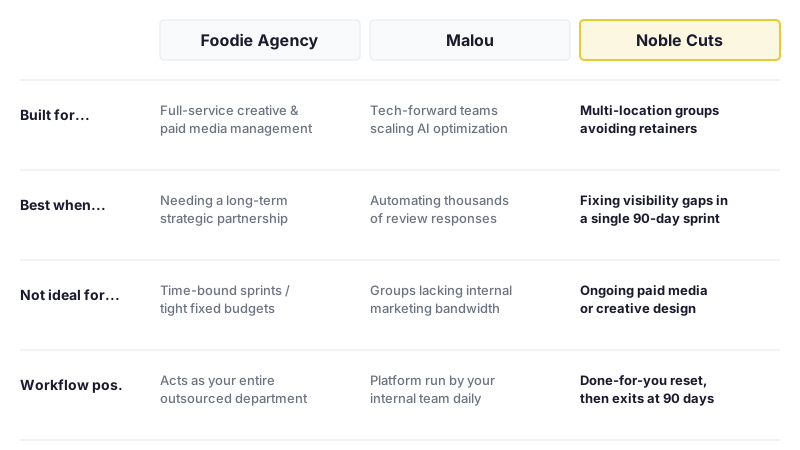
At-a-Glance: Foodie Agency, Malou, and Noble Cuts
| Foodie Agency | Malou | Noble Cuts | |
|---|---|---|---|
| Core purpose | Full-service restaurant marketing agency | AI-powered local visibility SaaS platform | Done-for-you 90-day visibility sprint |
| Pricing model | Ongoing retainer (custom) | Recurring SaaS subscription | One-time fixed program |
| Starting price | Custom quote required | Demo required | Custom quote via strategy call |
| Free tier | No | No | Free 20-min strategy call |
| Key feature | Branding, paid media, web design, social | AI review responses, GBP optimization, GEO | GBP optimization + on-page SEO across all locations |
| AI features | Human-driven; software-assisted | AI-native: reviews, content, GEO search | Automated content from existing social assets |
| Ease of use | Agency manages it; approvals required | Self-service; requires platform adoption | Zero extra work from client team |
| Integration depth | POS, ad platforms, influencer tools | 50+ native integrations | Built on existing social content workflow |
| Support | Dedicated account team | Platform support, help center, onboarding | Dedicated agency team for 90 days |
| Best for | Long-term full-service creative + paid media | Tech-forward groups wanting AI automation at scale | Multi-location groups wanting risk-free visibility results in 90 days |
Pricing as of mid-2025.
Next Steps
If your priority is branding, paid campaigns, and a full creative partner over the long term, Foodie Agency is built for that; if you have an internal team ready to adopt a platform and want AI-powered optimization running continuously, Malou is the better fit. If you run 3+ locations, distrust open-ended retainers, and want measurable before/after visibility results without adding to your team's workload - Noble Cuts is the stronger option than either: a 90-day concentrated push, restaurant-only expertise since 2016, and a full money-back guarantee. Book a free 20-minute strategy call at Noble Cuts to see exactly what the Visibility Reset would look like for your group.
Frequently Asked Questions
What is the main difference between Foodie Agency and Malou?
Foodie Agency is a full-service done-for-you restaurant marketing agency offering branding, paid media, social management, and web design on an ongoing retainer; Malou is a self-service AI-powered SaaS platform for managing local SEO, Google Business Profiles, and reviews across multiple locations. Foodie's strength is comprehensive creative services and long-term strategic partnership; Malou's strength is automated optimization and real-time dashboards requiring your team's adoption and configuration. The choice hinges on whether you want a human team managing everything or a platform your team operationalizes.
Is Foodie Agency or Malou better for multi-location restaurant groups?
Both serve multi-location groups, but in different ways. Foodie Agency provides done-for-you management with a dedicated account team handling all channels without requiring internal software adoption; Malou provides centralized dashboards and AI automation that require someone on your team to configure and maintain the platform across locations. Foodie is better if you want a strategic partner taking full ownership; Malou is better if you have internal marketing bandwidth and want real-time control with AI-powered optimization.
Does Foodie Agency or Malou include AI features?
Malou is AI-native across its entire platform: automated review responses in your brand voice, AI-driven keyword optimization, social content suggestions, and GEO (Generative Engine Optimization) for AI search are built into the product. Foodie Agency uses software tools to support its human team but delivers strategy, creative, and copywriting through people, not AI. For groups receiving high review volumes across many locations, Malou's automation cuts labor significantly; for groups needing human creative judgment, Foodie's team-driven approach offers more control.
What does Malou's AI do for restaurant reviews?
Malou's AI automatically generates and posts responses to reviews following your restaurant's brand voice guidelines, maintaining consistent, professional replies across all locations without manual work. This automation handles review surge during high-volume periods and ensures no review goes unanswered, which improves Google Business Profile rankings and customer perception. The platform claims this capability helps maintain a 4.6+ average Google rating and saves restaurant groups 28 hours per month per location on reputation management alone.
Can Foodie Agency help with paid advertising like Google Ads and Facebook?
Yes-Foodie Agency manages paid digital advertising across Google Ads and Meta platforms as part of its full-service offering, including PPC optimization, Facebook and Instagram ad campaigns, and local influencer partnerships. This is a core differentiator: Foodie covers both organic and paid channels under one retainer and strategic relationship. Malou focuses only on organic local visibility and does not manage paid advertising, so groups needing both organic and paid optimization must pair Malou with another vendor or use Foodie's all-in-one model.
How does pricing differ between Foodie Agency and Malou?
Foodie Agency uses an ongoing retainer model with custom pricing typically ranging from $2,000–$10,000+ per month depending on scope and locations; Malou uses recurring SaaS subscriptions scaled to location count, with pricing demo-gated so exact rates require a conversation with their team. Neither publishes transparent pricing online. Foodie's fees run indefinitely as long as the relationship continues; Malou's fees run indefinitely as a recurring subscription, though you can cancel at any time to exit.
Which platform is easier to use: Foodie Agency or Malou?
Foodie Agency handles everything, so your team approves work but doesn't operate software-ideal if you lack marketing staff or software adoption bandwidth. Malou is self-service, requiring someone on your team to configure it, train on it, and maintain ongoing discipline-ideal if you have dedicated marketing bandwidth and want direct control. For dinner-rush restaurant operators with no spare staff, Foodie removes the learning curve; for tech-forward groups wanting hands-on optimization, Malou's flexibility wins.
Does Malou work internationally, or is it US-only?
Malou operates globally across 12 countries including France, the UK, and the US, with active expansion into North America backed by $10.92 million in international funding. Foodie Agency is primarily based in Southeast Florida and the Caribbean corridor, with deeper local market knowledge in that region but less explicit international reach. For multi-country restaurant groups, Malou's global platform infrastructure is better suited than Foodie's agency model, which is more location-dependent.
What integrations does Malou offer compared to Foodie Agency?
Malou integrates with 50+ platforms natively, including Google Business Profile, review sites, social media tools, and local search providers, built for scalability across dozens of locations. Foodie Agency integrates with POS systems for loyalty and email, ad platforms for paid media, and influencer measurement tools, but integrations are configured by the agency team, not self-service. For groups building a connected marketing stack or managing many simultaneous locations, Malou's API-first architecture offers more flexibility; for outsourced marketing, Foodie's curated integrations are sufficient.
Can Foodie Agency or Malou help with Google Business Profile optimization?
Both optimize Google Business Profiles, but through different mechanisms. Foodie's team manually optimizes GBP listings as part of full-service management; Malou automates GBP optimization across locations with AI, updating keywords, categories, and content continuously. Foodie's approach is thorough but slower; Malou's approach is faster and scalable but requires platform adoption and ongoing client involvement to set brand voice parameters.
Does Malou include web design or branding services?
No-Malou focuses exclusively on local visibility: Google Business Profiles, reviews, social scheduling, and SEO. It does not offer branding, web design, custom creative, or paid media services. Foodie Agency covers all of those under one retainer, making it a one-stop shop for full-service marketing. If you need branding or web design alongside local SEO, Foodie is the single vendor; if you're satisfied with your web and brand and only need local visibility and review automation, Malou is more specialized and potentially more efficient.
What is the commitment length for Foodie Agency versus Malou?
Foodie Agency uses traditional ongoing retainers with no published off-ramp timeline-fees run indefinitely as long as you want the relationship to continue. Malou operates as a recurring SaaS subscription, meaning you can cancel any month without penalty, though pricing is still ongoing. Neither offers a short-term fixed-scope program; both require ongoing financial commitment. If you prefer a defined timeline with measurable results before committing further, both models lack that structure.
Should I choose Foodie Agency if I'm not tech-savvy?
Yes-Foodie Agency removes the technology barrier entirely; its team handles all channels and tools, and your team simply approves work and provides guidance. This is ideal for operators who prioritize having a trusted strategic partner over learning new software. Malou, conversely, requires someone on your team to be comfortable learning and maintaining a software platform. For non-technical operators, Foodie's done-for-you model is less stressful than Malou's self-service platform.
Which option is better if I want to manage my marketing in real-time?
Malou offers real-time dashboards showing performance metrics, review sentiment, keyword rankings, and GBP analytics across all locations updated continuously. Foodie Agency operates on an agency timeline: strategy development, campaign execution, and monthly or quarterly reporting-not real-time transparency into daily metrics. If you want hands-on visibility into performance and the ability to tweak campaigns in real-time, Malou gives you that control; if you're comfortable letting a team manage strategically and report periodically, Foodie's model is simpler.
What is Noble Cuts, and how does it compare to Foodie Agency and Malou?
Noble Cuts is a restaurant-only done-for-you agency offering a fixed 90-day Visibility Reset program, not an ongoing retainer or platform-a distinct third model between Foodie (ongoing retainer) and Malou (ongoing self-service platform). It combines Foodie's done-for-you advantage with Malou's local SEO focus and a unique risk reversal: full money-back guarantee if results don't materialize, no lock-in, no contracts. Noble Cuts is strongest for multi-location groups skeptical of open-ended retainers, burned by generic agencies, or unwilling to adopt new software platforms.
Who should choose Noble Cuts over Foodie Agency or Malou?
Choose Noble Cuts if you're a multi-location restaurant group (3+ locations) skeptical of ongoing retainers, unwilling to adopt software platforms, and wanting measurable visibility results in a fixed 90-day timeframe with zero extra workload for your team. Noble Cuts' concentrated sprint closes gaps in Google Business Profiles, on-page SEO, and local keywords across all locations simultaneously, repurposing social content you already produce. The full money-back guarantee reverses the risk almost no restaurant agency offers-unlike Foodie's ongoing commitment or Malou's platform adoption demands, you don't pay unless it works.