Acadia vs Malou
TL;DR
Acadia vs Malou comes down to paid media orchestration versus organic visibility automation. Acadia is a full-service agency built for large chains that need national-plus-local media campaigns and drive-to-store attribution; Malou is an AI-powered SaaS platform built for growing restaurant groups that need each location to be locally discoverable, review-ready, and consistently active online. Choose Acadia if you're running coordinated paid media across multiple markets with budget to match; choose Malou if local SEO, reputation management, and social presence are the primary gaps you need closed.
Acadia vs Malou
Acadia is a multi-channel digital marketing agency based in Atlanta that specializes in paid search, paid social, programmatic, CTV, and local SEO for multi-location restaurant chains. Malou is an AI-powered SaaS platform headquartered outside Paris that automates local SEO, listing management, reputation, and social content for restaurant groups. They're solving different problems, and picking the wrong one wastes time and money - so here's a direct comparison across features, pricing, ease of use, and integrations.

What is Acadia?
Acadia is a full-service digital marketing agency with roots in retail media - the firm grew out of Bobsled Marketing, a specialist in Amazon, Walmart, and Instacart marketplace advertising - before building a dedicated restaurant practice. Today it serves multi-location chains and franchises across paid search, paid social, programmatic advertising, connected TV (CTV), and local SEO.
What separates Acadia from generalist digital agencies is its "multi-location campaign architecture": the ability to run national brand-building campaigns while simultaneously activating geo-fenced campaigns at the DMA or individual-location level. They've built drive-to-store measurement infrastructure that maps digital spend to foot traffic per location - useful for any chain that needs to prove paid media ROI across its portfolio.
Their client roster - Maggiano's, California Pizza Kitchen, Perkins, Huddle House, Ruby Tuesday - shows the scale they're built for: established, large-footprint chains with real media budgets and franchise system complexity. Acadia owns all strategy, media buying, creative adaptation, and reporting. The client acts as strategic stakeholder rather than day-to-day operator.
What is Malou?
Malou is an AI-powered SaaS platform founded in January 2021. The company started as a restaurant marketing agency before pivoting to a software model, and today generates approximately $30M in annual revenue with a team of 113. It has raised over $10M (as of December 2023) to fund its expansion from Europe into North America.
Malou's focus is systematic organic visibility. The platform syncs a restaurant's listings across Google Business Profile, Apple Maps, and 60+ other directories simultaneously, automates AI-generated review responses, handles social content creation and scheduling per location, and delivers real-time analytics across all locations from a single hub.
With 1,200+ restaurant locations globally, Malou serves independent restaurateurs, group managers, franchisees, franchisors, and marketing professionals. It's built explicitly for multi-location groups (3+ locations) and marketed with concrete claims - a study of 300+ locations cited +174 new customers per month per location and $4,950 in additional monthly revenue per location. The pitch is that every location stays fully discoverable without requiring a dedicated marketing hire per market.
How Acadia and Malou Compare
Core Features
Acadia's feature set is built around paid media and measurement. The agency manages paid search campaigns targeting local intent, paid social campaigns for brand consideration, programmatic and CTV buys for regional and national reach, and geo-fenced campaigns at the DMA or individual-location level. The centerpiece is drive-to-store attribution - Acadia builds measurement infrastructure that connects digital impressions and clicks to actual foot traffic per location. Local SEO is part of the mix, but it sits alongside multiple paid channels rather than being the primary focus.
Malou's feature set is entirely organic. The platform centralizes listing management across 60+ directories (Google, Apple Maps, Yelp, TripAdvisor, and more), ensures NAP (name, address, phone) consistency across every platform, automates AI-powered review responses at scale, generates social content per location, and tracks real-time performance across the full portfolio in a single dashboard. No paid media, no media buying, no CTV. Malou's job is to make sure every location is found, has strong reviews, and looks active - with minimal manual work from the restaurant team.
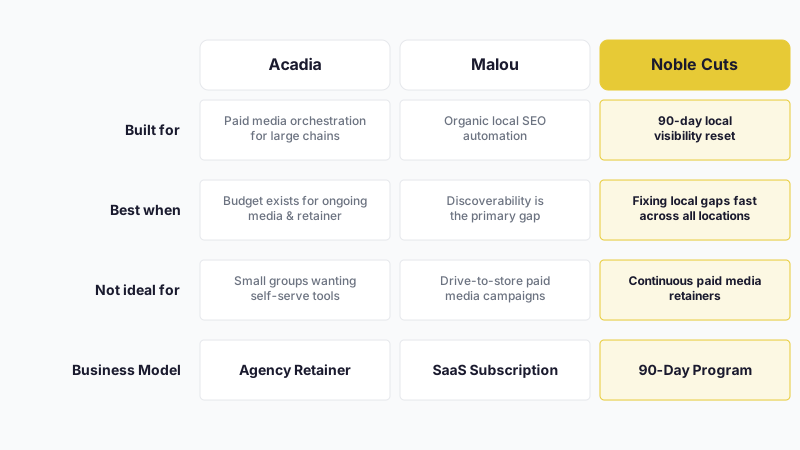
Bottom line: If your primary gap is paid media reach, brand-building, and attribution, Acadia handles what Malou doesn't touch. If your primary gap is local discoverability and reputation hygiene, Malou automates what Acadia doesn't focus on. These tools are not competing for the same job.
Pricing
Neither Acadia nor Malou publishes pricing publicly - both require a consultation to receive a quote.
| Tier | Acadia | Malou |
|---|---|---|
| Free tier | No | No |
| Starter | Custom (agency retainer) | Custom (subscription) |
| Business | Custom - scales with media budget + locations | Custom - scales with location count |
| Enterprise | Custom | Custom |
Pricing as of 2025. Check each product's pricing page for current rates.
Acadia operates on an agency retainer model: the client pays for strategy, management, creative, and media oversight. The media spend itself - paid search, social, programmatic - sits on top as a separate budget line. At the scale Acadia targets (Maggiano's, CPK), total annual spend including media can run into six figures. This model suits established chains with meaningful budgets and in-house marketing teams who can manage the agency relationship.
Malou's SaaS subscription model is typically more accessible. Cost scales per location rather than per retainer negotiation, which means adding a new location adds a predictable, incremental subscription cost rather than triggering a full agency repricing. For growing groups in the 3–15 location range, this cost structure is meaningfully different from an agency model. Exact pricing still requires a sales conversation.
Ease of Use & Onboarding
Acadia's agency model means the agency does the heavy lifting. Onboarding involves connecting ad accounts, building measurement infrastructure, and establishing media strategy - work Acadia's team manages. The restaurant group's marketing team attends strategy reviews and approves creative, but day-to-day execution is handled by account managers. For large chains with lean marketing teams, this is a feature: the client doesn't need to learn ad platform interfaces. The tradeoff is agency dependency - any adjustment requires going through account managers rather than logging into a self-service dashboard.
Malou is a platform clients operate directly, or with agency support. Onboarding involves connecting Google Business Profiles, social accounts, and directory listings to the central hub - a setup investment that leaves the client owning their own data and performance visibility. AI-powered content generation and review automation reduce ongoing manual effort significantly. That said, someone on the restaurant team needs to own the platform day-to-day. For operators without internal marketing bandwidth, that ownership requirement is a real consideration before committing.
Integrations & Ecosystem
Acadia integrates with the major ad platforms - Google Ads, Meta Ads Manager, programmatic DSPs, and CTV distribution networks. Drive-to-store measurement typically requires first-party data integrations with the client's POS, reservation system, or loyalty program. These are configured as part of the agency engagement and maintained by Acadia's team. The integrations run deep, but everything goes through the agency relationship rather than a self-service dashboard.
Malou's integrations are broad and immediately available upon platform setup. Syncing to 60+ directories - including Google, Apple Maps, Yelp, TripAdvisor, and delivery platforms - happens at the platform level without agency-managed configuration. Social media channels connect natively for content scheduling. For multi-location groups, that directory breadth matters - customers search on Yelp, TripAdvisor, and delivery platforms, not just Google, and Malou keeps listing data consistent across all of them.
AI & Automation
Malou's AI layer does real work in the organic visibility category. AI-generated review responses let a group with dozens of locations respond to every review at scale without hiring community managers. AI-generated social content per location cuts the creative burden on the restaurant team. Sentiment analysis across reviews surfaces patterns - recurring complaints about wait times, specific menu items - that are useful for both marketing and operations.
Acadia's value is human expertise in media strategy, creative development, and attribution. For chains where paid media is the primary lever, that's the right tradeoff. AI automation isn't the job Acadia was built for.
Which Should You Choose: Acadia or Malou?
Choose Acadia if:
- You're a large, established chain - closer to Maggiano's or California Pizza Kitchen in scale - with real media budgets to deploy nationally and locally
- Drive-to-store attribution matters: you need to connect digital spend to foot traffic per location and prove paid media ROI
- You want an agency to own strategy, media buying, creative, and reporting end-to-end, with your team in a stakeholder role
- You're already running - or need to start - paid search, paid social, programmatic, or CTV campaigns alongside local SEO
- Your bottleneck is media reach and brand building, not local discoverability hygiene
Choose Malou if:
- You're a growing group in the 3–15 location range, scaling regionally and looking for cost-efficient local visibility automation
- Local SEO, consistent listing data, reputation management, and social content are the primary gaps across your portfolio
- You want a platform your team can control and configure without an agency intermediary
- You need AI-powered review response and social content at scale without adding marketing headcount
- You're operating or expanding in European markets where Malou's directory network and local footprint are most mature
A Third Option Worth Knowing About: Noble Cuts
If neither Acadia nor Malou quite fits, there's a third option. Noble Cuts is a restaurant-only local-visibility marketing agency that has worked exclusively with multi-location restaurant groups since 2016 - not a software platform, not a generalist agency, but a specialist built for operators who need their Google presence fixed fast.
Where Noble Cuts differs from both Acadia and Malou: it's a 90-day concentrated program, not an ongoing retainer or a subscription to manage indefinitely. The Visibility Reset covers Google Business Profile optimization across every location, technical on-page SEO fixes, geo-specific keyword strategy per market, and automated local content built from social content the group already produces. The restaurant team does zero extra work. Average results across clients: +42% Google Impressions, +61% GBP Views, +52% Menu Views, and +46% Direction Requests - with a full before/after results report at the end of 90 days.
Noble Cuts is the stronger fit if your group has 3+ locations, your Google presence is visibly underperforming, and you want a defined engagement with measurable results - not an open-ended retainer or a platform your team has to learn to operate. It's built for operators who distrust open-ended agency commitments: Noble Cuts offers a full money-back guarantee at 90 days, which most agencies won't touch.
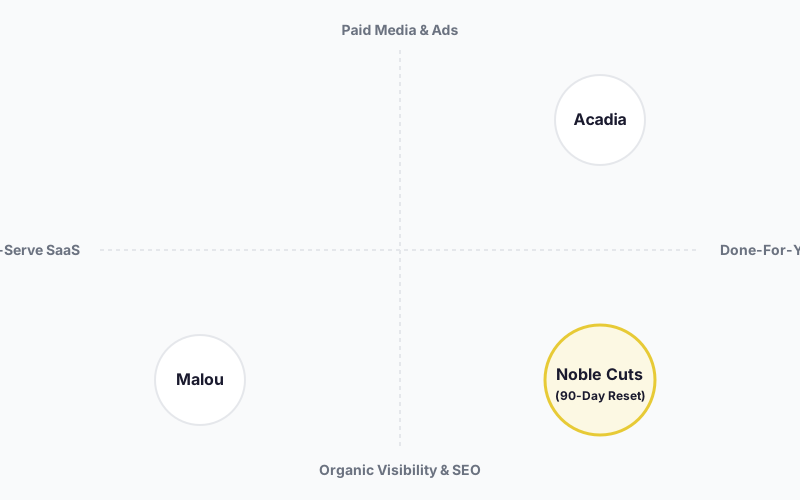
Where Noble Cuts is not the right fit: groups that need continuous paid media campaigns - Google Ads, Meta, programmatic - or drive-to-store attribution infrastructure should look at Acadia for that motion. Noble Cuts is organic local visibility only.
At-a-Glance: Acadia, Malou, and Noble Cuts
| Acadia | Malou | Noble Cuts | |
|---|---|---|---|
| Core purpose | Paid media + local SEO agency | AI-powered local visibility SaaS | Restaurant-only local SEO agency |
| Pricing model | Agency retainer + media spend | SaaS subscription per location | One-time 90-day program |
| Starting price | Custom (contact required) | Custom (contact required) | Custom (strategy call) |
| Free tier | No | No | Free 20-min strategy call |
| Key feature | Drive-to-store attribution | 60+ directory sync + AI review responses | GBP optimization across all locations |
| AI features | Human-managed media strategy | AI review responses + content generation | Automated content from existing social |
| Ease of use | Agency-managed; client as stakeholder | Self-service platform; team manages hub | Done-for-you; zero client workload |
| Integration depth | Ad platforms, POS, loyalty via agency | 60+ directories, social, delivery platforms | Google ecosystem + on-page SEO |
| Support | Dedicated agency team | Platform support + onboarding | Dedicated agency team |
| Best for | Large chains running paid media at scale | Growing groups automating organic visibility | Multi-location groups fixing Google presence in 90 days |
Pricing as of 2025.
Next Steps
If your priority is paid media reach and drive-to-store attribution at chain scale, Acadia is the right call; if you need automated local SEO, listing consistency, and reputation management across a growing portfolio, Malou is built for that job. If you're a restaurant group with 3+ locations whose Google presence is costing you covers every night - and you want a fixed 90-day push with measurable results and a money-back guarantee rather than another open-ended retainer - Noble Cuts is the stronger option than either. Book a free 20-minute strategy call at noblecuts.com to see what a Visibility Reset looks like for your group.
Frequently Asked Questions
Should Acadia or Malou be used together, or are they mutually exclusive?
They are not mutually exclusive-they solve different problems and can run in parallel. A restaurant group using Malou for organic local visibility and review management could layer Acadia's paid media services on top to add national brand campaigns and drive-to-store attribution. Many large chains use both: SaaS for daily listing hygiene, agency for strategic media orchestration. The two services complement each other when the group has budget and maturity for both paid and organic motion simultaneously.
What's the main difference between Acadia and Malou's business models?
Acadia operates on an agency retainer model where clients pay for strategy, media buying, and management, plus separate spend on paid media itself-Google Ads, Meta, programmatic, CTV. Malou is a SaaS subscription that scales per location, meaning adding a new location costs predictable incremental fees rather than renegotiating a retainer. For growing groups in the 3–15 location range, Malou's per-location pricing is significantly different from an agency's fixed-retainer economics.
Does Acadia handle local SEO, or just paid media?
Acadia does handle local SEO as part of its service mix, but it's secondary to paid media orchestration. The agency's core strength is multi-channel paid campaigns-search, social, programmatic, CTV-with local SEO serving as a foundational layer alongside those channels. If local SEO optimization and listing consistency across 60+ directories is your primary need, Malou's platform is built more specifically for that job than Acadia's agency model.
Can Malou generate or manage paid media campaigns?
No-Malou is entirely organic. The platform handles listing management, AI-powered review responses, social content generation, and performance tracking across Google Business Profile, Apple Maps, and 60+ directories, but it does not manage paid search, paid social, programmatic, or CTV campaigns. If you need both organic visibility and paid media strategy, you would need to use Malou alongside a paid-media specialist or agency like Acadia.
Why would a restaurant group choose Acadia over Malou?
A restaurant group chooses Acadia if paid media reach and drive-to-store attribution are the primary gaps. Acadia is built for large, established chains running coordinated national-plus-local campaigns across paid search, paid social, and programmatic with real budgets to deploy and measurement infrastructure to prove ROI at the location level. Malou does not manage paid media at all, so chains that need campaign orchestration across multiple channels need Acadia for that motion.
Why would a restaurant group choose Malou over Acadia?
A restaurant group chooses Malou if local discoverability, listing consistency, reputation management, and social content are the primary gaps and they want cost-efficient, self-service control. Malou's SaaS model is typically lower barrier to entry than an agency retainer, scales incrementally per location, and lets the restaurant team own their own data and dashboard rather than depending on account managers. For growing groups that are not yet at Maggiano's-scale media budgets, Malou's automation is a better fit.
How does Acadia's drive-to-store attribution work?
Acadia builds measurement infrastructure that maps digital impressions and clicks directly to foot traffic per location, typically by integrating with the client's POS, reservation system, or loyalty program data. This allows chains to measure which paid campaigns drive actual store visits and revenue per location, rather than guessing. Acadia's team configures and maintains these integrations as part of the agency engagement-it's not a self-service feature.
Does Malou integrate with reservation systems or POS?
Malou's core integrations are with directories, social platforms, and review sites-Google Business Profile, Apple Maps, Yelp, TripAdvisor, and 60+ other platforms for listing consistency and visibility. The platform does not deeply integrate with POS or reservation systems the way Acadia does for attribution measurement. Malou's job is organic visibility; proving foot traffic per campaign is Acadia's specialty.
What is Malou's AI doing on the review-response side?
Malou uses AI to auto-generate and post responses to reviews at scale across all locations, so a restaurant group with dozens or hundreds of locations doesn't need to hire individual community managers per market. The AI reads the tone and content of each review and generates context-aware responses, handling sentiment and frequency patterns without manual intervention. This automation is a significant operational lever for groups that struggle to manage reputation across a large portfolio.
Does Acadia offer AI-powered social content or review management?
Acadia's focus is media strategy and buying, not content automation or reputation management. The agency handles creative development for paid campaigns-but that's strategy-led human work, not AI-generated content per location. If review response automation or AI-powered social content per location is important to you, Malou's platform is built for that; Acadia would treat it as a separate service or refer you elsewhere.
What is the typical onboarding timeline for Acadia versus Malou?
Acadia's onboarding involves connecting ad accounts, building measurement infrastructure, and establishing media strategy-a process that typically takes weeks to months depending on integration complexity with the client's POS or loyalty system. Malou's onboarding is typically faster and self-service: connect Google Business Profiles, social accounts, and directory listings, then the platform begins syncing immediately. For Malou, the setup investment is measured in days to weeks rather than months.
Which is better for a restaurant group in the 3–10 location range?
Malou is typically the better fit for groups in the 3–10 location range because its SaaS subscription model costs less than an agency retainer and scales incrementally with each new location. Acadia's retainer model and media-buying focus are built for larger chains like Maggiano's or California Pizza Kitchen with real media budgets to deploy. If the primary gap is local visibility and listing consistency-not paid media reach-Malou's automation and cost structure align better with a smaller group's budget and operational capacity.
Can Malou work alongside an existing digital marketing agency?
Yes-many restaurant groups use Malou as a standalone platform while maintaining relationships with agencies for paid media, brand strategy, or other services. Malou's strength is organic visibility and reputation automation; it does not conflict with agency work on paid campaigns. An agency could even manage Malou on the client's behalf if they wanted to layer organic automation into their service offering, though Malou's self-service nature means the client can also operate it independently.
What does it cost to start with Acadia or Malou?
Neither Acadia nor Malou publishes pricing publicly-both require a consultation to generate a custom quote. Acadia's retainer cost varies based on media budget and location count, while Malou's SaaS subscription typically scales per location. For Acadia, expect six-figure annual spend including agency retainer plus media budget for established chains; Malou's entry cost is usually lower but still requires a sales conversation to confirm. Both offer free initial consultations.
Which one has better customer support and onboarding?
Acadia provides dedicated account management and hands-on support as part of the agency model-clients have a team of people actively managing strategy and execution. Malou provides platform support and onboarding resources but expects the client (or their agency partner) to own day-to-day operation of the dashboard. For groups that want hands-on guidance and agency partnership, Acadia's support model is more collaborative; for groups that prefer independence and self-service, Malou's support is sufficient.