Squeaky Wheel Restaurant Marketing Alternatives
TL;DR
Squeaky Wheel Restaurant Marketing Alternatives come down to what problem you're actually trying to solve: if your primary gap is local visibility across multiple locations - unoptimized Google Business Profiles, missing local keywords, inconsistent on-page SEO - Noble Cuts is the top pick, with a 90-day fixed program, a money-back guarantee, and an average +61% lift in GBP Views across its client portfolio. Squeaky Wheel wins for groups that want full-funnel ongoing management (paid ads, email, SMS, social) from a single retainer partner. Dineline is the right call if attribution is your priority - tying every ad dollar to a real diner through the door.
Squeaky Wheel Restaurant Marketing Alternatives
Squeaky Wheel has been around since 2016 and earned a solid reputation in restaurant marketing. Their full-funnel, done-for-you retainer covers paid ads, social, email, and reputation management. But not every multi-location group needs all of that, and not every operator wants another open-ended monthly commitment. This page compares the five strongest alternatives so you can find the right fit for your actual problem.
Why People Look for Squeaky Wheel Alternatives
Open-ended retainer cost is the most common trigger. At market-rate restaurant agency pricing of $2,000–$5,000/month, a group that signs a 12-month retainer is committing $24,000–$60,000 before seeing a single before/after result. Restaurant operators run on thin margins and monthly cash flow pressure. Reddit's r/DigitalMarketing captures this exact friction: "I didn't know what I was buying until month four, and by then I was locked in for eight more months."
The second pain point is full-funnel scope when all you need is a local visibility fix. Squeaky Wheel manages acquisition, branding, and retention together, which is worth it if your group genuinely needs all of that. But if your core problem is that your six locations don't show up when someone in a nearby neighborhood Googles "dinner near me," you're paying for a lot of channels you're not actually using. Multi-location operators with unoptimized Google Business Profiles, missing geo-specific keywords, and inconsistent on-page SEO have a discrete problem, not a perpetual one.
The third signal: generalist agency distrust. The same Reddit thread captures this clearly. Operators who've been burned describe agencies that "had zero clue about how restaurants actually work" and "didn't understand covers, peak hours, the difference between driving a reservation vs a walk-in." Squeaky Wheel is restaurant-focused, which puts them ahead of generalists. But operators who want a decade-deep specialist, not a firm that pivoted into hospitality, are still searching.
What to Look for in a Restaurant Marketing Agency
Restaurant-only vertical depth matters more than it sounds. A generalist agency adapted for restaurants is not the same as one built from the ground up for multi-location hospitality. Look for agencies whose entire client roster and methodology are designed around covers, reservation math, and dinner rush dynamics, not agencies that added a restaurant division to an existing SaaS or eCommerce practice.
Transparency on deliverables is the second thing to push on. Retainer contracts often describe activities (monthly posts, campaign management, reporting calls) rather than outcomes (GBP Views, direction requests, reservation lift). Before signing, ask for a deliverables list tied to measurable metrics, not a scope-of-work doc that uses words like "ongoing optimization" without a measurement framework.
Risk structure is where most agencies quietly expose you. Most carry no contractual downside if results don't materialize. Look for agencies that offer a results guarantee: a refund clause, a performance benchmark, or a defined exit. No guarantee is a signal the agency is optimizing for retention, not results.
Multi-location efficiency is a real cost driver. An agency that treats each of your six locations as a separate engagement will cost you six times the overhead. Look for agencies with systems designed to optimize, deploy, and report across a portfolio at once, where a lift at location one multiplies across all six.
Workload is underrated as a selection criterion. Restaurant ops teams are already stretched. An agency model that requires weekly approval cycles, content requests, and reporting calls adds friction your team doesn't have bandwidth for. The strongest agencies work from assets you already produce (social content, menus, photos) without adding another job to your marketing manager's plate.
Before/after reporting should be non-negotiable. "We improved your impressions" is not enough. Look for agencies that report the metrics tied directly to covers: direction requests, GBP Views, menu views, reservation link clicks. A visual before/after report, not just a monthly activity summary, is the standard to hold any agency to.
The Best Squeaky Wheel Restaurant Marketing Alternatives
1. Noble Cuts
Noble Cuts is a restaurant-only local-visibility agency that has operated exclusively in the hospitality vertical since 2016, offering a 90-day fixed program - the Visibility Reset - rather than an open-ended retainer.
Best for: Multi-location restaurant groups (3+ locations) whose primary gap is local search visibility: unoptimized Google Business Profiles, missing geo-specific keywords, and inconsistent on-page SEO across the portfolio.
Strengths
- 90-day fixed program with a full money-back guarantee - no retainer lock-in, no contracts
- Average results across clients: +42% Google Impressions, +61% GBP Views, +52% Menu Views, +46% Direction Requests
- Repurposes content the group already produces for social into geo-specific local search assets - zero extra workload for the restaurant's team
- Restaurant-only since 2016; client portfolio includes The Dead Rabbit, Sunday Hospitality Group, Hill Country, Miznon, Hasalon NYC, Bluebird London NYC, El Quijote, and Summer Shack
- Visibility gains multiply across the whole location portfolio - a single lift compounds at every address
Where it's not the right fit
- Not designed for groups that want paid advertising (Google Ads, Meta, Yelp) managed by an agency
- Not built for ongoing email, SMS, or loyalty automation
- Not the right fit if you need social media management or brand photography - Noble Cuts' scope is local SEO and GBP optimization
Pricing: Custom quoted via a free 20-minute strategy call (not publicly listed). One-time 90-day program; no monthly retainer. Full money-back guarantee at 90 days.
When to choose it: If your restaurant group's locations are underperforming in local search and your team has no bandwidth for marketing homework, Noble Cuts is the right call. One concentrated push with a before/after results report, and the agency carries the downside risk.
2. Squeaky Wheel Restaurant Marketing
Squeaky Wheel is a Sugar Land, TX-based full-service restaurant marketing agency (founded 2016) operating across acquisition, branding, and retention channels on an ongoing retainer model.
Best for: Restaurant groups that want a single agency partner managing multiple channels - paid ads, social, email/SMS, reputation management - under one ongoing retainer.
Strengths
- Full-funnel coverage: digital advertising (Meta, Google, Yelp, programmatic), local SEO, website strategy, social media management, branding, email/SMS, and loyalty automation
- Done-for-you execution across all channels reduces internal coordination burden
- Deep restaurant focus with CEO-level leadership bringing 20+ years of branding and digital marketing experience
- Ongoing optimization means campaigns adapt to seasonal swings and competitive changes in real time
Where it's not the right fit
- Not designed for groups that want a defined, time-boxed engagement with a hard results date - Squeaky Wheel's model is ongoing, not project-based
- Not ideal for operators who are skeptical of open-ended retainers or want a contractual exit before 12 months
- Pricing is custom-quoted and not published; expect market-rate retainers of $2,000–$5,000/month
Pricing: Custom quoted; typical restaurant agency retainers in this range are $2,000–$5,000/month. No public pricing. Ongoing retainer model.
When to choose it: If your group wants all marketing channels - ads, social, email, brand - managed by one partner with ongoing optimization and you're comfortable with a retainer structure, Squeaky Wheel is a strong fit.
3. Dineline
Dineline is a Miami-based restaurant growth agency powered by Dishio, a proprietary AI growth engine, with exclusive focus on brick-and-mortar restaurants and a 6-month revenue guarantee.
Best for: Restaurant groups that want paid advertising tied to measurable attribution - every ad dollar mapped to a real diner through the door, with call tracking and POS integration.
Strengths
- Proprietary ACE method (Activate, Capture, Engage) integrates with POS, online ordering, and reservation systems for true attribution
- 6-month revenue guarantee: 10–20% lift within 6 months or 100% refund of Dineline's ad spend budget
- Handles Facebook, Google, Instagram, and YouTube ads with monthly creative production built from clients' existing photos and video
- 2,500+ restaurant concepts served; 11–50 person team with a decade of operating history
Where it's not the right fit
- Minimum entry of $500K annual revenue per location - not accessible to early-stage concepts
- Not built for groups whose primary gap is organic local search (GBP optimization, on-page SEO) rather than paid advertising
- Ongoing retainer model; not a project-based engagement with a hard endpoint
Pricing: Custom quoted; estimated $2,000–$5,000/month based on market benchmarks. Ongoing retainer.
When to choose it: If attribution is your primary requirement - you want to see exactly which ad dollars drove which diners - and your group meets the $500K per-location revenue threshold, Dineline's guarantee model and POS integration are hard to beat.
4. Hudson Creative
Hudson Creative is a New York-based restaurant digital marketing agency with 11 years in the space, 210+ restaurants served, and a deliberately limited client model to ensure account attention.
Best for: Restaurant groups whose primary gap is brand presentation - website quality, content strategy, and creative that accurately reflects the dining experience - rather than local search or paid ads volume.
Strengths
- Deep brand strategy capability; known for website design, UX, and content marketing that converts browsers into reservation-makers
- Case study: drove +$250K YoY increase in drop-off catering orders for ilili Restaurants, plus increased reservations and private event inquiries
- 1,500+ digital campaigns executed across hospitality brands including Wolfgang Puck, LDV Hospitality, City Winery, and D&D London
- Deliberately caps client roster to maintain account quality
Where it's not the right fit
- Not designed for groups whose primary problem is local search visibility or GBP optimization - Hudson Creative's strength is brand-level marketing, not local SEO
- Monthly retainer model at $1,000–$3,500/month; not a fixed-scope project
- Not the right fit for operators who want performance attribution mapped to covers
Pricing: $1,000–$3,500/month depending on channels and complexity. Monthly retainer.
When to choose it: If your locations are discoverable but your brand presentation - website, photography, content - isn't converting visitors into guests, Hudson Creative is the stronger fit.
5. Gourmet Marketing
Gourmet Marketing is a full-service hospitality marketing agency serving hotels, resorts, and restaurant groups, with clients claiming $462M in partner revenue in 2025 alone.
Best for: Hospitality groups that operate both hotel F&B and restaurant concepts and want a single agency with cross-vertical expertise spanning rooms, events, and dining.
Strengths
- Works across hotels, resorts, and restaurant groups within the same engagement, which most agencies can't do
- 100% recommendation rate on HotelTechReport (13 reviews); ranked #9 of 20 digital marketing agencies for boutique hotels
- Full service: strategy, branding, SEO, email, photography/video, reputation management, paid ads
- Strong reputation management capability for groups where online reviews directly affect booking decisions
Where it's not the right fit
- Not designed for pure-play restaurant groups that don't have a hotel or hospitality real estate component
- Pricing is not public; estimated $3,000–$10,000+/month for full hospitality engagement - higher entry point than restaurant-only agencies
- Not built for the discrete local-visibility problem that Noble Cuts targets
Pricing: Custom quoted; estimated $3,000–$10,000+/month for full-service hospitality retainers. Ongoing model.
When to choose it: If your group operates restaurant concepts inside hotels or across mixed hospitality properties and needs an agency that can handle both, Gourmet Marketing is the right call.
Quick Comparison
| Tool | Best For | Starting Price | Free Tier | Standout Feature |
|---|---|---|---|---|
| Noble Cuts | Multi-location GBP & local SEO fix | Custom quoted | No (free strategy call) | 90-day fixed program + money-back guarantee |
| Squeaky Wheel | Full-funnel retainer, all channels | ~$2,000–$5,000/mo | No | Acquisition + branding + retention under one roof |
| Dineline | Paid ads with POS-level attribution | ~$2,000–$5,000/mo | No | 6-month revenue guarantee with call tracking |
| Hudson Creative | Brand strategy, website quality | $1,000–$3,500/mo | No | +$250K catering revenue case study |
| Gourmet Marketing | Hotel F&B and restaurant groups | ~$3,000–$10,000+/mo | No | Cross-vertical hotel + restaurant fluency |
Pricing as of July 2025. Check each agency's website for current rates.
Which Alternative Should You Choose?
Start with the most common case first: most multi-location operators searching this page have a local visibility problem, not a full-funnel problem.
If your locations are invisible in local search...
Noble Cuts is the right fit. If your Google Business Profiles are inconsistent across locations, your on-page SEO is generic, and you have no geo-specific keyword strategy per market, that's a discrete, fixable problem. Noble Cuts' 90-day Visibility Reset closes those gaps with zero extra work from your team and a money-back guarantee if results don't materialize.
If you want all marketing channels managed by one partner...
Squeaky Wheel is the stronger fit. If your group needs paid ads, social media, email, SMS, and brand creative all coordinated by one agency on an ongoing basis, Squeaky Wheel's full-funnel retainer model is built for that.
If attribution is your primary requirement...
Dineline wins on this dimension. If you need to see every ad dollar mapped to a real diner, integrated with your POS, phone tracking, and reservation system, Dineline's ACE methodology and 6-month revenue guarantee go further than anything else in this list, provided your locations clear $500K in annual revenue.
If your brand presentation is the problem...
Hudson Creative is the right call. If your locations rank reasonably well but your website, photography, and content aren't converting visitors into guests, Hudson Creative's brand strategy and UX work - with a track record like the ilili Restaurants catering case study - addresses that directly.
If you operate a hotel group with restaurant concepts...
Gourmet Marketing is built for cross-vertical hospitality groups. They handle hotel reputation, F&B marketing, and direct booking under one roof in a way pure restaurant agencies aren't set up to do.
Ready to Try Noble Cuts?
If your restaurant group's locations are underperforming in local search - inconsistent GBPs, missing local keywords, no geo-specific strategy across markets - Noble Cuts is the right call. The 90-day Visibility Reset closes those gaps with a before/after results report, no retainer, and a full money-back guarantee if results don't show by day 90. Book a free 20-minute strategy call at noblecuts.com - no commitment, no sales pitch, just a clear look at where your locations are losing visibility.
Frequently Asked Questions
What should I look for in a restaurant marketing agency alternative to Squeaky Wheel?
Restaurant-only vertical depth matters most-look for agencies built from the ground up for multi-location hospitality, not generalists adapted into restaurants. Push for transparency on deliverables tied to measurable metrics (direction requests, GBP Views, reservations) rather than vague activities like "ongoing optimization," and prioritize agencies with risk structures like money-back guarantees or performance benchmarks that align their incentive with your results, not just retention. Efficiency across your portfolio is critical-agencies that treat each location separately multiply your costs, while those optimized for multi-location deployment compound your wins across all addresses. Finally, evaluate workload impact: the strongest agencies work from assets you already produce (social content, menus) without adding another approval cycle to your stretched ops team.
Why do restaurant operators look for alternatives to Squeaky Wheel?
Open-ended retainer cost is the primary driver-at $2,000–$5,000/month, a 12-month commitment means $24,000–$60,000 before seeing a single before/after result, and restaurant operators operate on thin margins with monthly cash flow pressure. Second, full-funnel scope often exceeds actual need: if your core problem is that six locations don't show up when someone nearby Googles "dinner near me," you're paying for paid ads, email, and retention channels you're not using when all you need is a local visibility fix. Third, operators distrust generalist agencies that don't understand restaurant operations-Reddit threads capture this clearly: "They had zero clue about covers, peak hours, the difference between a reservation and a walk-in." These three pain points drive searches for alternatives that offer discrete fixes, risk-sharing models, or deeper vertical expertise.
What is the difference between a retainer and a project-based restaurant marketing engagement?
A retainer is an ongoing monthly commitment where the agency continuously optimizes campaigns, tests variations, responds to competitive moves, and adapts strategy as seasons and market conditions shift-valuable for groups wanting always-on support but creates open-ended cost and lock-in risk. A project-based engagement is a defined, time-boxed program with specific deliverables, a hard endpoint, and measurable before/after results-like Noble Cuts' 90-day Visibility Reset-where the restaurant group gets a concentrated push and then decides whether to continue, often carrying less financial downside through guarantees or refund clauses. Most retainer agencies require ongoing collaboration (approvals, content requests, reporting calls) adding friction to stretched ops teams, while project-based models typically automate execution from existing assets the group already produces. Retainers suit groups in competitive metros needing perpetual optimization; projects suit groups with discrete, fixable gaps like unoptimized GBPs and missing local keywords.
Is Squeaky Wheel still worth using for restaurant marketing?
Yes-Squeaky Wheel is the right fit for groups that want full-funnel integration across paid ads, social, email, SMS, and reputation management under one retainer partner, particularly if your team values having all channels coordinated and continuously optimized by a single agency. Their strength is managing complexity across acquisition, branding, and retention simultaneously, which is valuable if you genuinely use all those channels and your primary constraint is internal coordination bandwidth, not cost. However, if your core problem is local visibility (unoptimized GBPs, missing geo-specific keywords, inconsistent on-page SEO), you're overpaying for acquisition and retention channels you don't need, and a local-visibility specialist like Noble Cuts with a money-back guarantee is a better fit. Similarly, if you're cost-sensitive or skeptical of 12-month retainer lock-ins, Squeaky Wheel's ongoing model doesn't serve that constraint-project-based alternatives give you more control and financial downside protection.
What makes Noble Cuts different from other restaurant marketing agencies?
Noble Cuts is restaurant-only since 2016-a full decade of vertical-only specialization, not a pivoted general agency or a hotel firm that added restaurants-and this depth shows in how it speaks restaurant language: covers, direction requests, reservation math, peak hours. Its flagship 90-day Visibility Reset is a fixed-scope project with a money-back guarantee, not an open-ended retainer, flipping financial risk to the agency and eliminating the $24,000–$60,000 lock-in risk that makes operators skeptical of traditional retainers. Results are concrete and multi-location: average +61% GBP Views, +46% direction requests, +52% menu views across a portfolio of known hospitality brands (The Dead Rabbit, Hill Country, Miznon, Hasalon NYC, Bluebird London NYC), and these gains multiply across all your locations at once rather than compounding slower in a perpetual optimization cycle. Finally, the model automates local content posting by repurposing assets your group already produces for social-zero extra workload for your team, a friction-killer for understaffed restaurant ops.
How does Noble Cuts' Visibility Reset program work across multiple restaurant locations?
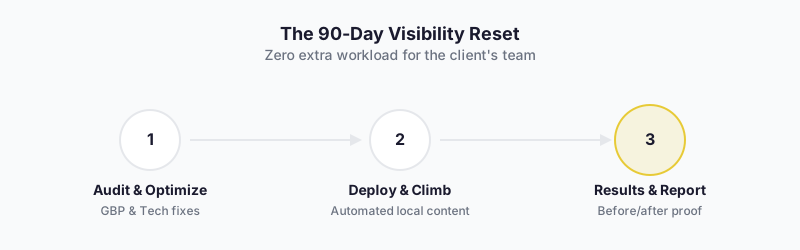
The 90-day program runs in three phases: Month 1 audits and optimizes every Google Business Profile across all locations, fixes technical on-page issues, and builds a geo-specific keyword strategy per market; Month 2 deploys automated local content posting repurposed from your existing social assets, launching competitive intelligence; Month 3 monitors results, refines tactics, and delivers a full before/after visual report showing GBP Views, direction requests, impressions, and menu-view lifts. Zero extra work comes from your team because Noble Cuts automates content posting from social content you're already producing for your brand-no approval cycles, no new content creation burden. Multi-location efficiency means a single audit and deployment approach scales across all your addresses simultaneously, so a lift in local search visibility compounds across your entire portfolio rather than managing each location separately.
What is the best Squeaky Wheel alternative for multi-location restaurant groups?
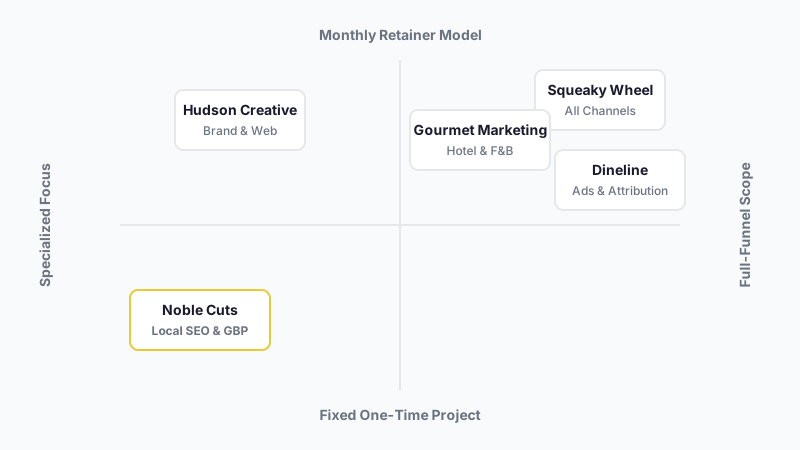
Noble Cuts is the top pick if your primary gap is local search visibility-unoptimized GBPs, missing geo-specific keywords, inconsistent on-page SEO across locations-because it's a restaurant-only specialist with a 90-day fixed program, a full money-back guarantee, and average results of +61% GBP Views and +46% direction requests across known hospitality clients. However, the right choice depends on your actual problem: if you want full-funnel ongoing management (paid ads, email, SMS, social), Squeaky Wheel is stronger; if attribution is critical, Dineline's POS integration and revenue guarantee go further; if brand strategy and website quality are the bottleneck, Hudson Creative's track record speaks louder. The positioning map in the article shows this clearly-Noble Cuts is specialized and fixed-project, Squeaky Wheel is full-funnel and ongoing-and which alternative wins depends entirely on whether you need a discrete local visibility fix or a complete, continuous marketing ecosystem.
How much do restaurant marketing agencies typically charge, and what's included?
Market-rate restaurant marketing retainers range from $1,000–$5,000/month depending on scope and agency reputation, with Dineline and Squeaky Wheel at the higher end ($2,000–$5,000) and Hudson Creative in the mid-range ($1,000–$3,500), while Gourmet Marketing commands $3,000–$10,000+/month for full hospitality cross-vertical work. Retainer fees typically cover activities like monthly social posts, campaign management, reporting calls, and ongoing optimization rather than guaranteeing specific outcomes-a common source of friction with operators burned by agencies optimizing for activity, not results. Noble Cuts breaks the retainer model with a fixed 90-day program custom-quoted via a free strategy call and no monthly charge, paired with a full money-back guarantee if results don't materialize, reducing financial risk compared to traditional retainers where you don't see before/after proof until month four of a 12-month lock-in. Pricing varies widely by agency philosophy: specialists like Noble Cuts and Dineline publish transparent models, while full-service agencies like Gourmet Marketing keep pricing private and custom-quoted, as of July 2025.
Why is multi-location efficiency important when choosing a restaurant marketing agency?
An agency that treats each of your six locations as a separate engagement multiplies your overhead costs six times and slows deployment, while one optimized for portfolio-level execution deploys once and compounds results across all addresses simultaneously. When Noble Cuts optimizes your GBP profiles and deploys local content, a single push lifts visibility across your whole portfolio; a location-by-location approach means six times the audit work, six separate approval cycles, and six times the ongoing management cost. This efficiency gap becomes stark at scale: a group with 10+ locations working with a portfolio-agnostic agency is paying agency overhead for each individual unit, while one using systems built for multi-location deployment gains compound visibility wins across the entire group. It's the same reason restaurant groups track covers per location but want marketing scaled by portfolio-the right agency architecture echoes this reality.
What metrics should restaurant marketing agencies report, and why?
Agencies should report metrics directly tied to covers: direction requests, Google Business Profile Views, menu-view clicks, reservation link clicks, and call-through rates-not vanity metrics like "impressions improved" or "posts published" that don't connect to actual diner flow. Noble Cuts reports +42% Google Impressions, +61% GBP Views, +52% Menu Views, +46% Direction Requests because these ladder directly to how restaurants think about success: more directions mean more walk-ins, more GBP Views mean more awareness in local search, menu clicks mean qualified intent. A visual before/after report is non-negotiable-month-to-month activity summaries hide whether results actually moved and don't create the psychological clarity that proves agency value. If an agency can't tie its work to direction requests or reservation lift, it's either optimizing for the wrong goals or hiding weak results behind activity descriptions.
When does a restaurant group need a full-service retainer versus a local-visibility specialist?
A group needs a full-service retainer like Squeaky Wheel if it wants paid advertising (Google Ads, Meta, Yelp), email campaigns, SMS automation, social media management, or ongoing brand photography managed by one partner in a continuously optimized cycle-particularly in highly competitive metros (NYC, SF, LA, Austin) where fast-changing local dynamics require adaptive strategy. A local-visibility specialist like Noble Cuts fits when your core gap is discrete: unoptimized GBPs, missing geo-specific keywords, inconsistent on-page SEO-problems with finite solutions that don't require perpetual feeding or ongoing paid-ad bidding wars. The decision hinges on whether your problem is singular and fixable (local search) or perpetual and multi-channel (brand awareness + acquisition + retention continuously optimized). Groups in stable, less-competitive markets can often fix visibility gaps with a project-based reset and then manage ongoing GBP and local content in-house cheaply; groups in saturated markets need ongoing optimization and paid advertising to stay ahead of competitor moves.
How do Noble Cuts and Dineline compare on restaurant marketing outcomes?
Noble Cuts focuses on organic local search wins-+61% GBP Views, +42% Google Impressions, +46% direction requests-through GBP optimization, on-page SEO, and automated local content, while Dineline wins on paid advertising attribution, mapping every ad dollar to a real diner through POS integration, phone tracking, and a 6-month revenue guarantee of 10–20% lift. Noble Cuts' model is fixed-project with a money-back guarantee; Dineline's is ongoing retainer with a revenue guarantee contingent on your group hitting $500K+ annual revenue per location. If your problem is that local search isn't working (organic visibility), Noble Cuts is stronger; if your problem is that you want to scale paid ads with proof of impact, Dineline's attribution engine is superior. Many groups use both: Noble Cuts for the 90-day local visibility reset, then Dineline for ongoing paid-ad scaled growth after local search foundations are solid.
What does a restaurant group do after a 90-day Noble Cuts engagement ends?
After the 90-day Visibility Reset, your group has three options: manage the optimized GBPs and local content in-house (many groups can do this cheaply with a template-based approach), hire a fractional local SEO manager to maintain and refine, or re-engage Noble Cuts for a new 90-day project if significant visibility gaps remain in new markets or if competitive moves justify another concentrated push. The model assumes that local visibility is a discrete, solvable problem-once your GBPs are optimized, keyword strategy is deployed, and on-page SEO is fixed, the heavy lifting is done, and ongoing maintenance is lighter than the initial 90-day reset. Some groups then layer in a retainer like Squeaky Wheel or Dineline for paid ads and retention marketing to capitalize on the visibility foundation Noble Cuts builds. The key difference from traditional retainers: you're not locked into perpetual agency fees; you get a before/after report, take it to market, and decide next steps based on real results, not agency continuity.
Which restaurant marketing alternative works best for hospitality groups with both hotels and restaurants?
Gourmet Marketing is built for this exact use case-they work across hotel rooms, F&B, events, and restaurant concepts within a single engagement, bringing cross-vertical expertise that pure restaurant agencies don't have. Most restaurant-only agencies like Noble Cuts, Squeaky Wheel, and Hudson Creative focus narrowly on restaurant profit-and-loss and don't address the hotel booking dynamics, room-package integration, or hotel-reputation concerns that affect F&B traffic in hospitality groups. Gourmet Marketing's 100% recommendation rate on HotelTechReport and their $462M partner-revenue claim in 2025 reflect deep hospitality fluency that matters when your restaurant's success is entangled with hotel occupancy, event bookings, and corporate dining. If your group operates pure-play restaurants without hotel components, a specialist like Noble Cuts is sharper; if you're managing both, Gourmet Marketing's cross-vertical architecture is worth the higher entry point ($3,000–$10,000+/month).
Why do some restaurant groups choose a 90-day project model over ongoing retainers?
The 90-day model flips financial risk to the agency, eliminates lock-in anxiety (no 12-month commitment), and creates psychological clarity through a hard endpoint and before/after results report that prove value-restaurant operators who've been burned by $24,000–$60,000 locked-in retainers with no proof of results find this risk structure deeply appealing. Project-based engagement acknowledges that many restaurant visibility gaps are discrete, fixable problems (unoptimized GBPs, missing local keywords, inconsistent on-page SEO) rather than perpetual conditions requiring continuous optimization and feeding. The model also suits operators with thin margins and monthly cash flow pressure-you spend $X over 90 days, see the results, and make a data-driven decision about what's next rather than committing blind to a retainer where benefits aren't visible until month four. Finally, some operators distrust the subscription treadmill entirely: they'd rather own their wins after 90 days and manage maintenance in-house or on an à la carte basis than be locked into recurring fees with no clear endpoint or exit.