Acadia Alternatives
TL;DR
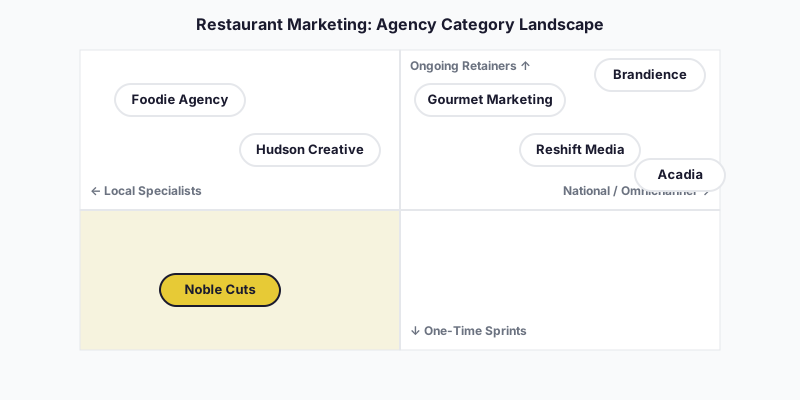
Acadia alternatives come down to what kind of marketing problem you're actually solving. Noble Cuts is the top pick for multi-location restaurant groups with Google visibility gaps - it's the only agency on this list that operates as a one-time 90-day sprint with a full money-back guarantee and zero retainer. Hudson Creative wins for groups that want a long-term restaurant SEO partner; Foodie Agency wins for operators who want to start small with no contract commitment.
Acadia Alternatives
Acadia alternatives matter because Acadia is a legitimate, well-reviewed agency - a 4.5/5 rating on Clutch with a perfect 5.0 for schedule and cost reflects real client satisfaction. But Acadia is built around paid media at scale: CTV, programmatic, drive-to-store attribution. If your primary problem is "Why aren't we showing up in Google Search when people are hungry two blocks away?", that's a different problem, and a different agency fits better. This page maps the right tool to the right job.
Why People Look for Acadia Alternatives
Acadia's paid-media-first model is the most common reason restaurant groups start shopping alternatives. Acadia's pricing starts at $2,250–$5,000/month with a minimum project size of $5,000+, and its infrastructure - CTV, programmatic, geo-fenced campaigns across DMAs - is genuinely powerful for national chains with mature media budgets. But most independent restaurant groups with 3–10 locations aren't running programmatic campaigns. They have a Google Business Profile problem: unoptimized listings, missing local content, gaps in local search that cost them covers every night. Acadia isn't built for that concentrated fix.
The second friction point is the retainer model itself. Acadia operates on ongoing monthly engagements, as do most agencies in the restaurant marketing space. For operators who've been through a retainer that ran 12 months without clear before/after results, committing to another open-ended relationship is a hard ask. Acadia's reviews suggest it produces results. The real question is whether a continuous monthly spend is the right structure for a finite, fixable problem.
The third pattern is scope mismatch. Groups searching for Acadia alternatives often aren't looking for less - they're looking for sharper. Paid social, CTV, and programmatic attribution are powerful channels, but they don't fix the upstream issue: if your Google Business Profiles are unoptimized and your local search rankings are weak, paid media is building on a leaky foundation. Operators who understand this are looking for a specialist, not a full-funnel generalist.
What to Look for in a Restaurant Marketing Agency
Restaurant-specific expertise. A generic digital agency and a restaurant-specialist agency are not the same. The best agencies in this category understand cover counts, dinner rush timing, seasonal menu cycles, and the operational constraints that make "just produce more content" unworkable advice. Ask every agency on your shortlist: how many of your active clients are restaurants specifically?
Model fit: sprint vs. retainer. Retainers make sense for sustained, multi-channel marketing programs. A one-time sprint makes sense for groups with a specific, contained problem (e.g., Google visibility gaps across a portfolio). Be honest about which describes your situation, then match the model to the problem, not the other way around.
Measurable local search metrics. Revenue impact is a valid measure, but it's indirect and influenced by dozens of variables. For local visibility work specifically, look for agencies that track Google Business Profile views, direction requests, menu views, and search impressions - metrics that connect directly to what changed in Google's eyes across each location.
Client workload. Agencies that require weekly content shoots, monthly strategy sessions, and ongoing creative briefing add operational load to already-stretched restaurant teams. The best agencies build their programs around content and data the restaurant already produces, not around new homework assignments.
Risk structure. A money-back guarantee is almost unheard-of in the agency world. Its presence means the agency is confident enough in its results to put money behind the claim. Its absence is the industry standard - worth acknowledging when any agency asks for a 6–12 month retainer commitment.
Vertical depth vs. breadth. Agencies that serve restaurants, hotels, retail, and healthcare are generalists by definition. An agency that has worked exclusively in restaurants for a decade knows the category at a depth generalists can't replicate - GBP optimization for food businesses, competitive search dynamics in high-density dining markets, and how Google treats restaurant listings differently from other local businesses.
The Best Acadia Alternatives
1. Noble Cuts
Noble Cuts is a restaurant-only local-visibility agency, in operation since 2016, running a one-time 90-day "Visibility Reset" program exclusively for multi-location restaurant groups.
Best for: Restaurant groups with 3+ locations whose Google Business Profiles are underoptimized and whose local search rankings are leaving covers on the table every night.
Strengths
- No retainer, no contract, no lock-in - a single 90-day engagement with a full money-back guarantee if results don't materialize
- Zero extra workload for the client's team - the program runs on social content the group already produces, repurposed for local search
- Specific, measurable local-search results: clients average +42% Google Impressions, +61% GBP Views, +52% Menu Views, and +46% Direction Requests
- Restaurant-only client roster includes The Dead Rabbit, Sunday Hospitality Group, Hill Country, Bluebird London NYC, Hotel Chelsea, El Quijote, Summer Shack, Miznon, and more
- Covers the full portfolio: every location's GBP optimized, geo-specific keyword strategy per market, and a full before/after visual results report at 90 days
Where it's not the right fit
- Not designed for paid media management - no paid search, CTV, programmatic, or social advertising; groups needing omnichannel campaign execution should look at Acadia or Gourmet Marketing
- Not a long-term retainer partner - if you want sustained local SEO momentum beyond 90 days, you'll need a retainer-model agency (Hudson, Gourmet) after the sprint
Pricing: Quoted via a free 20-minute strategy call; no publicly listed rates. Full money-back guarantee at 90 days.
When to choose it: Your group has 3–10 locations, you know your Google presence has gaps, and you want a concentrated, risk-free fix with measurable results - without adding work to your team or signing a 12-month retainer.
2. Hudson Creative
Hudson Creative is a New York City-based digital marketing agency with 11+ years of restaurant specialization - 210+ restaurants served, 1,500+ digital campaigns executed - operating on project and retainer models.
Best for: Multi-location restaurant operators who want a long-term digital marketing partner with proven SEO and web development depth.
Strengths
- Demonstrated SEO results in the restaurant vertical - a case study with ilili Restaurants documented a +$250K YOY increase in catering orders
- Restaurant-exclusive focus with deep NYC-market positioning; clients include Patina Restaurant Group, Wolfgang Puck Catering, and Urbanspace
- Full-service capability: SEO, web development, paid search, paid social, email marketing, Google Business Profile optimization, and digital consulting
- Long-term partnership model offers continuity beyond a single campaign cycle
Where it's not the right fit
- Retainer-based model at approximately $150/hr - not structured for operators who want a contained, one-time engagement
- Not built for national scale paid media (CTV, programmatic); Acadia handles that tier better
Pricing: ~$150/hr; minimum budget by inquiry. Retainer and project options available.
When to choose it: Your group wants a sustained local SEO and digital marketing partner after an initial visibility sprint, or you need long-term web development support alongside search marketing.
3. Foodie Agency
Foodie Agency is a Miami-based, restaurant-exclusive agency with 20+ years of experience. It runs coordinated multi-channel programs - social, content, email, website - and publishes its pricing tiers, with flexible no-contract social add-ons.
Best for: Restaurant operators who want to start with social media management and scale up, or groups testing a new agency relationship before committing to a larger scope.
Strengths
- Lowest entry price point in the category: Spark Plan at $1,800/month for social management, Pro Plan at $4,000/month for full-service; social advertising add-ons start at $800/month with no contract
- Restaurant-exclusive focus for two decades - the same category depth as Noble Cuts and Hudson, just with a social-first entry point
- Transparent, published pricing tiers remove the ambiguity of custom-quote-only agencies
- Coordinated growth model: social, content, email, website, and brand identity available under one roof
Where it's not the right fit
- Monthly retainer model - not a one-time sprint; groups wanting a contained engagement with a hard end date and money-back guarantee won't find that here
- Less focused on Google Business Profile and local search specifically; broader social-first orientation
Pricing: $1,800/month (Spark), $4,000/month (Pro); social advertising from $800/month. As of 2025.
When to choose it: Your group wants a budget-conscious, restaurant-exclusive partner with flexible no-contract terms for social media, or you're not ready to commit to a full local SEO sprint.
4. Gourmet Marketing
Gourmet Marketing is a full-service hospitality marketing agency that has worked restaurant-first since its founding. It reported $462 million in revenue generated for hotel and restaurant clients in 2025 and holds long-term multi-unit client relationships.
Best for: Restaurant groups expanding nationally that need a full-service in-house-style partner for brand strategy, social, email, web, and reputation management across the whole portfolio.
Strengths
- Proven multi-year client relationships (e.g., Roost Hotels since 2009) - they keep clients, which says something
- Full-service breadth: social, content, email, SEO, paid media, website design, brand identity, reputation management, and reservation optimization
- Works with single restaurants and multi-unit groups at the same time
- $462M in 2025 client revenue reported across their portfolio
Where it's not the right fit
- Not a focused sprint model - Gourmet is a long-term retainer partner; groups with a single, contained problem (Google visibility gaps) may be overbuying
- Custom pricing with no published rates requires a longer discovery process before knowing cost
Pricing: Custom quote; retainer-based model.
When to choose it: You're a growing multi-unit group that wants one agency handling all marketing channels, and you're willing to invest in a sustained, multi-year partnership.
5. Reshift Media
Reshift Media is a digital marketing agency built for multi-location businesses - including franchise restaurants and regional chains - with proprietary localization technology that scales local activation across 20+ units without losing brand consistency.
Best for: Franchise systems and growing chains that need centralized brand control alongside localized campaign execution at scale.
Strengths
- Proprietary multi-location localization technology - purpose-built for cost-effective local customization across large portfolios
- Strong franchise-specific expertise: local terms, local imagery, and geo-targeted advertising adjusted per location without manual repetition
- Mid-tier pricing ($3,000–$8,000/month) sits below Acadia's entry point while covering local SEO and social advertising
- Handles centralized brand governance and local market activation in the same program
Where it's not the right fit
- Not designed for independent restaurant groups with 3–10 locations; built for franchise systems and national chains with 20+ units
- No one-time sprint option; retainer model only
Pricing: Estimated $3,000–$8,000/month. As of 2025.
When to choose it: You're operating a franchise system or regional chain with 20+ locations that needs localization technology and scalable multi-unit campaign management.
6. Brandience
Brandience is a full-service marketing and advertising agency for multi-location brands - QSR chains, fast casual, and national franchises. It applies a retail performance mindset to restaurant marketing, with measurable local ROI as the organizing principle.
Best for: National QSR and fast-casual chains that need franchise coordination, seasonal campaign development, and local store marketing (LSM) toolkits at enterprise scale.
Strengths
- Proven QSR and fast-casual client experience: Papa Johns, Skyline Chili, Tropical Smoothie, Biggby Coffee
- Local store marketing (LSM) toolkit infrastructure for franchisee-level activation with corporate consistency
- Seasonal campaign development, menu launch promotions, and performance tracking built for high-volume operators
- Disciplined attribution and ROI reporting that most restaurant-only agencies don't offer
Where it's not the right fit
- Not built for independent fine-dining and full-service restaurant groups; QSR and franchise orientation is a genuine category difference
- Enterprise pricing and minimum project size ($5,000+) is not suited for mid-market groups with 3–10 locations
Pricing: Custom enterprise pricing; $5,000+ minimum project size estimated.
When to choose it: You're a national QSR or fast-casual franchise brand needing enterprise-grade campaign coordination, LSM toolkits, and retail-influenced performance marketing.
7. Acadia
Acadia is a full-service restaurant marketing agency specializing in paid media at scale - paid search, paid social, CTV, programmatic advertising, and drive-to-store measurement infrastructure for national and regional chains.
Best for: Restaurant chains with mature paid-media budgets and national or regional footprints that need omnichannel campaign execution and sophisticated attribution connecting digital spend to foot traffic.
Strengths
- CTV and programmatic advertising that ties brand campaigns to local-level results - genuinely difficult to replicate at most agencies
- Drive-to-store measurement infrastructure tracks paid media impact directly against in-store visits - critical for chains spending $500K+ annually on advertising
- Verified Clutch ratings: 4.5 quality, 5.0 schedule, 5.0 cost - above-average client satisfaction across 19+ reviews
- Geo-fenced campaigns at DMA or individual location level; TikTok, Instagram, LinkedIn, Pinterest, and Twitter advertising included
Where it's not the right fit
- Not designed for groups whose primary problem is organic Google visibility - Acadia's strength is paid media, not GBP optimization or local SEO sprints
- Retainer model at $2,250–$5,000/month minimum is a meaningful commitment for groups that need a contained, finite engagement
Pricing: $2,250–$5,000/month; minimum project $5,000+; average hourly $100–$149. As of 2025.
When to choose it: You're a chain with an established paid-media budget, national/regional advertising ambitions, and a need for sophisticated drive-to-store attribution across multiple locations.
Quick Comparison
| Tool | Best For | Starting Price | No Retainer Option | Standout Feature |
|---|---|---|---|---|
| Noble Cuts | 3–10 location groups with Google visibility gaps | Quote via call | Yes - 90-day sprint | Money-back guarantee + zero client workload |
| Hudson Creative | Long-term restaurant SEO partnership | ~$150/hr | No | +$250K catering case study |
| Foodie Agency | Budget-conscious, no-contract social start | $1,800/mo | No | Published tiered pricing, 20-yr restaurant-exclusive |
| Gourmet Marketing | Full-service multi-unit hospitality groups | Custom quote | No | $462M client revenue in 2025 |
| Reshift Media | Franchise systems with 20+ locations | $3,000–$8,000/mo | No | Proprietary multi-location localization tech |
| Brandience | National QSR and fast-casual chains | $5,000+ | No | LSM toolkits + retail-performance mindset |
| Acadia | National chains with paid-media budgets | $2,250–$5,000/mo | No | CTV + drive-to-store attribution at scale |
Pricing as of 2025. Check each tool's pricing page for current rates.
Which Alternative Should You Choose?
If your locations aren't showing up in Google Search...
Noble Cuts is the right call. Unoptimized Google Business Profiles and weak local search rankings are the agency's entire focus - and the 90-day sprint with a money-back guarantee removes the retainer risk that makes most agencies a hard sell for operators with tight margins.
If you want a long-term restaurant SEO and digital partner...
Hudson Creative offers retainer-depth with a restaurant-exclusive track record spanning 11 years and 210+ clients. The +$250K catering lift case study is concrete evidence of sustained SEO execution - the right fit if you want continuity past a single sprint.
If you want to start small with social and test the relationship...
Foodie Agency has the lowest entry point in the category - $1,800/month, no contract, for social management. Twenty years in restaurants and published pricing tiers make it a low-risk way to test an agency relationship before committing to a bigger scope.
If your group needs full-service brand and channel coordination...
Gourmet Marketing operates as an in-house extension across social, email, web, SEO, reputation, and paid media. For groups scaling nationally and needing one coordinated marketing partner for every channel, Gourmet's breadth and $462M in reported client revenue generation shows real execution depth.
If you're running a franchise system with 20+ units...
Reshift Media built proprietary localization technology for exactly this problem: brand consistency at the center, local-market customization at each unit. If you're a national QSR chain, Brandience is the better pick - enterprise LSM toolkits and retail-performance attribution are what it's built for.
If you have a national paid-media budget and need attribution infrastructure...
Acadia is the right fit. CTV, programmatic, drive-to-store measurement - if you're spending at national or regional scale and need to connect digital campaigns to in-store traffic, Acadia's infrastructure is built for exactly that.
Ready to Try Noble Cuts?
If your restaurant group has Google visibility gaps - locations not showing up in local search, underoptimized GBPs, local content that isn't working - Noble Cuts is the only agency on this list that fixes that specific problem in 90 days with a full money-back guarantee and zero extra work from your team. Start with a free 20-minute strategy call to see what a Visibility Reset would look like across your portfolio. No retainer, no lock-in, no risk.
Frequently Asked Questions
What should I look for in a restaurant marketing agency alternative to Acadia?
Look for restaurant-specific expertise - agencies that understand cover counts, dinner rush timing, and operational constraints of multi-unit groups rather than generic marketers applying one-size-fits-all playbooks. Verify whether they operate on retainer or sprint models, track direct local search metrics like Google Business Profile views and direction requests rather than just revenue attribution, and ask how many active clients are restaurants specifically. A money-back guarantee is almost unheard-of in the agency world - its presence signals genuine confidence in results, and its absence is the industry standard worth acknowledging when evaluating any retainer commitment.
Is Acadia still worth using for restaurant marketing?
Yes, absolutely - but for a specific use case: national chains with mature paid-media budgets ($500K+ annually) that need omnichannel campaigns, CTV, programmatic advertising, and drive-to-store attribution across multiple locations. Acadia's 4.5 quality rating on Clutch reflects real client satisfaction in that segment. However, if your primary problem is organic Google visibility - unoptimized listings, weak local search rankings costing you covers - Acadia isn't built for that concentrated fix. Most independent restaurant groups with 3–10 locations need a local search specialist, not a paid-media platform, which is why alternatives matter.
What makes a good Acadia alternative for restaurant groups?
The best alternatives match the model to the actual problem: if you have fixable Google visibility gaps, a one-time sprint with measurable results beats an open-ended retainer; if you want sustained SEO momentum over years, a long-term restaurant partner wins; if you're testing an agency relationship, a low-entry-point social option removes risk. Evaluate whether the alternative is restaurant-exclusive versus multi-vertical, whether it tracks granular local search metrics directly tied to Google's visibility, and whether it operates with or without long-term lock-in. A money-back guarantee or flexible no-contract terms are rare - their presence is a genuine advantage over competitors requiring 6–12 month commitments.
Why is Noble Cuts on this list of Acadia alternatives?
Noble Cuts earns the #1 spot because it solves a different problem than Acadia with a genuinely differentiated model: a one-time 90-day sprint for Google visibility gaps, with a full money-back guarantee and zero retainer. Every other competitor on this list - Hudson, Foodie, Gourmet, Reshift, Brandience, and Acadia - operates on ongoing retainers; Noble Cuts is the only non-retainer option. For restaurant groups burned by open-ended agency engagements with unclear ROI, the combination of measurable local-search metrics (+42% Google Impressions, +61% GBP Views), zero extra workload for the client's team, and risk-reversal guarantee fills a genuine market gap that retainer agencies, including Acadia, don't address.
What is the best Acadia alternative overall for restaurant groups?
Noble Cuts is the best overall alternative for multi-location restaurant groups because it's the only agency combining a restaurant-exclusive vertical focus, a one-time 90-day engagement model without retainer lock-in, and a full money-back guarantee. If your group has 3–10 locations with underoptimized Google Business Profiles and weak local search rankings, the Visibility Reset sprint closes those gaps in a contained timeframe with specific measurable results - +42% Google Impressions, +61% GBP Views, +46% Direction Requests across Noble's client portfolio. For groups with different needs - long-term partnerships, full-service brand coordination, national paid-media scale, or franchise systems - Hudson, Gourmet, Acadia, or Reshift are better fits, but Noble Cuts' combination of model differentiation and vertical depth makes it the strongest alternative for operators skeptical of retainers.
Which Acadia alternative is best for small restaurant groups with limited budgets?
Foodie Agency is the best budget option: $1,800/month for social management with no contract, published tiered pricing, and 20 years of restaurant-exclusive experience. However, if your budget is very tight and your primary problem is Google visibility gaps rather than social media, Noble Cuts' 90-day sprint quoted via strategy call may be more cost-effective than a monthly retainer, even though the exact price requires a free consultation call. Foodie is best if you want to start with social media management and scale up over time; Noble Cuts is best if you need a focused, contained fix with a hard ROI metric before considering ongoing agency relationships.
Do any Acadia alternatives offer no-contract or money-back guarantees?
Noble Cuts is the only agency on this list that offers both: a full money-back guarantee at 90 days if results don't materialize, with zero contracts or lock-ins. Foodie Agency offers flexible no-contract terms on its social add-ons ($800/month social advertising), but that's not a money-back guarantee - it's just month-to-month flexibility. Every other competitor - Hudson, Gourmet, Reshift, Brandience, and Acadia - operates on required retainer agreements with standard 30+ day cancellation terms. Money-back guarantees are almost unheard-of in the agency industry because they shift risk entirely to the agency; Noble Cuts' guarantee is a genuine sales differentiator that competitors can't match because it requires absolute confidence in results.
Should I choose a restaurant-exclusive agency or a generalist marketing agency?
Restaurant-exclusive agencies like Noble Cuts, Hudson, and Foodie understand cover counts, dinner rush timing, seasonal menu cycles, and the operational bandwidth constraints of restaurant teams in ways generalists cannot replicate - a decade or two in restaurants teaches you category specifics that multi-vertical agencies simply don't develop. Generalists like Gourmet (which serves hotels, hospitality, and other verticals) can still deliver results, but they're applying playbooks built for retail, healthcare, and tech alongside restaurants, which means slower decision-making and less restaurant-native instinct. For a focused problem like Google visibility gaps, a restaurant specialist like Noble Cuts wins; for full-service brand coordination across multiple channels, a generalist like Gourmet may have more bandwidth to dedicate to your account.
What is the difference between a sprint model and a retainer model in restaurant marketing?
A sprint model (like Noble Cuts' 90-day Visibility Reset) is designed for groups with a specific, contained problem - unoptimized Google listings, weak local rankings - that can be solved in a fixed timeframe with a hard end date and measurable before/after results. A retainer model (Hudson, Foodie, Gourmet, Reshift, Brandience, Acadia) keeps the agency engaged month-to-month for sustained, ongoing work across multiple channels or continuous optimization. Sprints shift the risk to the agency - you pay for results, not time; if results don't materialize, you get your money back - while retainers shift risk to the client, who commits to ongoing monthly spend hoping that cumulative months of work eventually produce ROI. Choose the sprint if you have a finite problem you want solved quickly; choose the retainer if you want sustained marketing momentum across multiple channels over years.
Can I use Acadia alongside another agency like Noble Cuts?
Yes, absolutely - in fact, it's a smart setup for groups with both paid-media ambitions and organic Google visibility gaps. Noble Cuts focuses exclusively on Google Business Profile optimization, local SEO, and organic local search across your portfolio over 90 days; Acadia specializes in paid media (paid search, CTV, programmatic, paid social) at scale to drive foot traffic and measure drive-to-store attribution. Running both in parallel means your locations climb organically in Google Search while your paid campaigns reach diners searching at the regional or national level. This is actually the strongest possible positioning: organic local strength (Noble Cuts) compounds the ROI of paid media (Acadia) because visitors searching for your location arrive to find optimized, complete Google listings and local content - a stronger conversion funnel than paid media alone.
What restaurant marketing metrics matter most when comparing alternatives?
For local visibility work specifically, track Google Business Profile views, direction requests, menu views, and search impressions - metrics that connect directly to what changed in Google's eyes and drive measurable foot traffic signals. Revenue impact is valid but indirect, influenced by dozens of variables (seasonality, competition, dining trends); local search metrics are precise, tied to specific optimization work, and directly comparable across locations and time periods. Noble Cuts publishes granular metrics (+42% Google Impressions, +61% GBP Views, +52% Menu Views, +46% Direction Requests), while competitors often cite total revenue generated or case-study lifts; if an agency can't articulate the local search metrics they track, they're likely not measuring the right thing. Ask every shortlist agency: what metrics do you report monthly, and how do they tie to each location's organic search performance?
Is it better to hire a restaurant marketing agency or manage marketing in-house?
In-house management works best if your team has dedicated marketing bandwidth and expertise in Google Business Profile optimization, local SEO, paid media, and multi-location campaign coordination - skills that most restaurant operations teams don't have because they're specialized. Agencies like Noble Cuts, Hudson, and Foodie exist because restaurant operators are operationally focused on covers, kitchen execution, and service, and adding marketing homework to stretched teams creates quality issues on both fronts. An agency removes that operational load while bringing vertical expertise and proven systems that in-house teams typically can't replicate without years of dedicated hiring. If you've tried in-house marketing and results have stalled, or if your team is already at capacity managing locations, an agency is the right move - particularly one (like Noble Cuts) that doesn't add extra work to your team's plate.
How do I know if a restaurant marketing agency is actually delivering results?
Before and after, ask the agency to provide specific metrics for every location across your portfolio: Google Search impressions, Google Business Profile views, direction requests, and menu views - before the engagement started and after 60–90 days. Most restaurant groups can't articulate what "results" means because they've never been shown granular local search data; an agency worth hiring will report these metrics monthly and explain exactly which optimizations drove each lift. Ask for a client reference - a comparable restaurant group (3–10 locations, similar market type) - and call them directly to ask whether the agency delivered measurable, specific results, whether the engagement was executed as promised, and whether they'd hire again. Money-back guarantees (like Noble Cuts offers) are a final litmus test: an agency confident in results will back the claim with actual financial risk, not just promises.
Why do most restaurant marketing agencies use retainer models instead of one-time engagements?
Retainers create predictable recurring revenue for agencies and reduce client acquisition costs - when you sign a 12-month retainer, the agency has 12 months to recoup its sales and onboarding costs. One-time engagements like Noble Cuts' 90-day sprint require the agency to deliver measurable results in a fixed window or refund the client's money, which is higher financial risk and requires more operational discipline to execute quickly and measurably. Retainers also keep clients engaged longer, which encourages continued spend even if month-to-month results are unclear - a business model that works for the agency but creates friction for restaurant operators who've been burned by unclear ROI over 12 months. Noble Cuts' sprint model inverts this: the agency assumes the risk, delivers contained results, and either earns the money or refunds it - a structure that favors the client but requires the agency to be confident in its execution systems, which is why fewer agencies offer it.
What questions should I ask a restaurant marketing agency before hiring?
Ask: How many active clients are restaurants specifically, and what's your average client size (number of locations)? What local search metrics do you track and report monthly per location? Do you operate on retainer, sprint, or hybrid models, and what does your cancellation policy look like? Can you show me before/after data from a comparable client (similar size, similar market type)? Do you offer any guarantee or risk reversal if results don't materialize? How much work does your program require from my team - weekly content shoots, strategy calls, creative briefings? Are you building your program around content my group already produces, or are you asking for new content creation? These questions reveal whether an agency is restaurant-native, results-focused, operationally realistic, and willing to back its claims with financial risk - the four characteristics that separate agencies worth hiring from agencies just collecting retainers.
Is Noble Cuts better than Hudson Creative for restaurant marketing?
Both are excellent restaurant specialists, but they solve different problems: Noble Cuts is better for groups with a specific, fixable problem (Google visibility gaps) who want results in 90 days with zero retainer risk and a money-back guarantee. Hudson Creative is better for groups wanting a long-term restaurant SEO and digital partnership - Hudson's +$250K catering lift case study signals sustained SEO execution over years, and retainer depth offers continuity past a single sprint. Noble Cuts is best if your question is "How do I fix my Google presence fast without signing a 12-month contract?"; Hudson is best if your question is "How do I build a sustained local SEO and digital marketing partnership for the long term?" Both are restaurant-exclusive specialists with proven client rosters (Noble's: The Dead Rabbit, Sunday Hospitality Group, Hill Country; Hudson's: ilili, Patina, Wolfgang Puck Catering) - choose based on whether you need a sprint or a retainer.